


Dr. Oleksandr (Sasha) Kondrashov
Draft Statement
This comparative analysis should be considered a draft document intended to promote further discussion. Additional perspectives and insights, particularly from directly impacted communities in both Canada and Ukraine, need to be incorporated to fully capture the complex lived experiences and collective traumas stemming from the oppressive passport and pass systems examined here. This remains a tentative attempt to shed light on troubling policies targeting ethnic groups and restricting mobility. Further dialogue and relationship building is necessary to reckon with this difficult history in ethical, meaningful ways. There is still much work to be done.
Introduction
Both USSR and Canada have deployed restrictive internal “pass” systems aimed at controlling the movements of people and tying them to particular localities. This comparative analysis examines the emergence, features, and impacts of the Soviet passport regime directed largely against rural Ukrainian peasants from 1932-1974 and Canada’s Indigenous pass system active primarily from 1885-1935. Despite key differences stemming from distinct historical contexts and target populations, exploring salient similarities and differences reveals how in both cases documentation requirements enabled sweeping mobility restrictions, exploitation, rights violations, and enduring collective traumas for the affected populations.
Canada’s Pass System
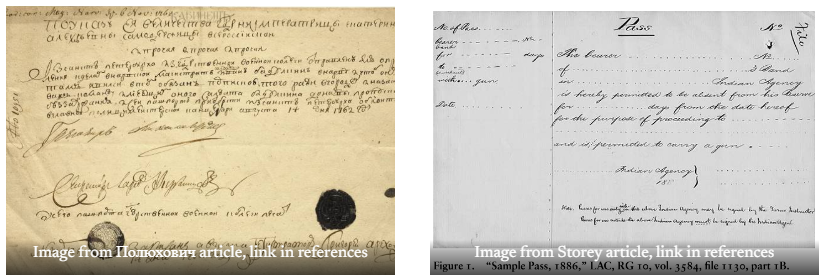
The pass system emerged in 1885 as a localized administrative measure to restrict the mobility of First Nations bands in Western Canada following the Northwest Rebellion. As Barron outlines, government officials like Hayter Reed saw the pass system as a necessary means to “curb Indian mobility” in line with the broader goal of confining Indigenous peoples to reserves to facilitate their assimilation (Barron, 1988, pp. 28-29). The Northwest Rebellion had also triggered anxieties about Indigenous alliances and threats to colonial regime, further motivating mobility restrictions.
Lacking legal grounds, the pass system stipulated that First Nations peoples required authorized travel documents from Indian Agents to leave their reserves. The North-West Mounted Police (NWMP) would then enforce these restrictions and return those found without appropriate passes (Barron,1988, pp. 34-35). In practice, many Indigenous peoples resisted these constraints on their mobility by either defiantly travelling without passes or slipping away from reserves unnoticed.
Storey argues, the pass system disrupt Indigenous mobility, governance structures and ceremony participation into the 20th century in many areas (Storey, 2022, pp. 156-157). For instance, his case studies illustrate officials using passes to prevent ceremony attendance and to confine particular bands to reserves. Storey thus challenges the notion that Indigenous opposition rendered the pass system an outright “nullity” in practice, emphasizing its enduring oppressive impacts (Storey,2022,p. 139).
The documentary “The Pass System” (Williams, 2015) brings attention to Canada’s hidden history of racially segregating Indigenous peoples through internal pass systems. Elders from tribes like the Nehiyaw, Saulteaux, Dene, Ojibwe and Niitsitapi share first-hand experiences of living under and resisting these oppressive restrictions on reserves into the 20th century. Acclaimed artists and scholars provide context on the unjust system and its enduring traumatic impacts. The documentary gives voice to survivors while exposing the colonial roots of mobility restrictions and linking their legacy with present-day Indigenous human rights issues.
The Soviet Ukrainian passport system that developed shortly afterwards bore some marked similarities in enabling far-reaching mobility restrictions and rights violations against rural people in Ukraine.
Soviet Ukraine Passport System
The passport system was introduced in Soviet Ukraine in 1932, tying peasants to collective farms (kolkhozes) by excluding rural areas from passportization (Полюхович, 2021). As Pivovarov details, passports were initially only issued to urban residents, workers and state farm employees, while rural inhabitants lacked any identity documents, effectively becoming “serfs” (Пивоваров, 2019).
Both sources emphasize how the passport system deprived peasants of freedom of movement for decades. Without passports, they needed the village council and collective farm chairman’s permission just to travel outside their locality (Полюхович, 2021). Violators faced fines, arrest and years of imprisonment. This allowed local authorities to exploit peasants, particularly women (Полюхович, 2021).
The passport system bound peasants to the land, mirroring serfdom and violating previous treaties made with peasants (Полюхович, 2021). As Pivovarov notes, peasants only received passports in 1974, ending five decades of restrictions. Before then, some did manage to “buy” documents through bribes, enlistment or moving to remote construction sites (Пивоваров, 2019).
Ultimately, beyond initial repression, the unequal passport system gave the Stalinist regime an instrument to control population flows and engineer society as desired, albeit with uneven enforcement. For rural Ukrainians, it meant the loss of rights their ancestors had fought for.
Despite originating in distinct contexts, the Soviet and Canadian pass systems targeted particular ethnic groups, enabling sweeping mobility restrictions that violated individual liberties and collective autonomy for local populations over many decades. Exploring key similarities and differences sheds light on these tools of oppression.
Here are a list of similarities and differences between the Soviet Ukraine passport system and the Indigenous pass system in Canada that I noted from the articles I read:
Similarities:
Both were used to restrict freedom of movement and mobility of certain groups – peasants in Ukraine, First Nations bands in Canada.
The systems required special documents/passes to travel outside one’s locality, which were issued and controlled by authorities.
Lack of compliance with the systems often resulted in arrest, fines or even imprisonment.
Pass systems endured for decades – from 1885-1935 in a more limited capacity in Canada; from 1932 to 1974 more strictly in Soviet Ukraine.
Both systems emerged partly in response to resistance movements – the Northwest Rebellion/Resistance in 1885 in Canada, collectivization resistance in the early 1930s in Soviet Ukraine.
Peasants/First Nations resisted the constraints through defiance, bribery and leaving without permission.
Authorities like Indian Agents and collective farm chairmen were involved in enforcing restrictions.
Unequal application of pass restrictions to certain ethnic/social groups. Denial of rights that had been granted to other groups.
Disruption of traditional governance structures, ceremonies, cultural practices due to mobility restrictions.
Long-term consequences for autonomy and self-governance stemming from restrictions.
Creation of new ways of living arrangements (reserves and kolchozes) to control populations
Differences:
The Canadian pass system originated as a localized measure rather than national legislation.
Canada’s pass system explicitly focused on First Nations bands, while Ukraine’s encompassed the entire rural Ukrainian communities.
Documentation took the form of travel passes in Canada rather than internal passports in Ukraine.
Canadian pass system was inconsistently enforced, whereas Ukraine’s system hardened into binding law by the 1930s.
Canadian system intended to facilitate Indigenous assimilation to reserves; Ukraine’s aimed to bolster agricultural collectivization.
Canadian system spearheaded by the NWMP, Ukraine’s by Communist Party officials via decrees and legislation.
Canadian system is better recognized now as an oppressive and damaging policy, recent documentaries are made to preserve the history; soviet oppression of Ukrainian peasants is still being denied by russian federation, USSR successor. Ukraine is in the process of documenting stories of survivals of pass system.
The Canadian government has at least acknowledged the oppressive legacy of the pass system and broader Indigenous assimilation policies through a formal apology to residential school survivors, although criticism remains over the lack of meaningful action to address enduring harms. In contrast, russian authorities continue denying the Soviet regime engaged in any targeted persecution of Ukrainians while suppressing evidence of Holodomor atrocities. russia since February 2022 launched full-scale invasion in Ukraine.
Despite being divided by nearly 50 years of history and an ocean, the Indigenous and rural Ukrainian experiences with internal “documentation regimes” share disturbingly similar themes of restriction, exploitation, and collective punishment that continue echoing through to the present. However neither Canada nor Ukraine, has yet fully reckoned with this difficult history nor met demands from activists for justice regarding these identity-based mobility constraints and related campaigns of ethnic persecution persisting even into the current times.
The comparative analysis reveals how administrative surveillance systems, when applied unequally against diverse populations, easily transform into tools of dehumanization with generational consequences. Thus while specifics differed, the pass systems in both Canada and USSR speak to the dangers of normalizing oppression and collective punishment rather than forthrightly addressing underlying grievances and injustices. Their bitter legacy should stand as a warning to avoid replicating such policies targeting ethnic, or other minority groups in the name of state security.
Acknowledgements
I would like to acknowledge that my understanding of the impacts of the passport system and collectivization policies in Soviet Ukraine comes primarily from the experiences shared within my own family and information I research online. However, I have comparatively less direct insight into the enduring harms caused by Canada’s Indigenous pass system from First Nations community members themselves. Further work needs to be done to elevate and center the voices of those most affected by the oppressive mobility restrictions imposed on reserves. Building relationships and listening to the stories of survivors and descendants is vital for non-Indigenous peoples like myself to gain a fuller appreciation of this troubling history and its modern reverberations. I hope this analysis prompts greater dialogue and truth seeking efforts addressing the painful legacy of Canada’s pass system in Indigenous communities and impact of USSR passport system on rural Ukrainian people. More research need to be done to listen to stories of survivors of pass/passport oppressive regimes from both Canada and Ukraine.
References
Полюхович, Д. (2021, January 21). Радянське кріпацтво. Як комуністи зробили з селян «другий сорт» і не хотіли їх «озброювати паспортами». Texty.org.ua. https://texty.org.ua/articles/102792/radyanske-kriposne-pravo-yak-komunisty-zrobyly-iz-selyan-druhyj-sort-i-ne-hotily-yih-ozbroyuvaty-pasportamy/
Пивоваров, С. (2019, August 28). Сорок пʼять років тому селяни в СРСР уперше отримали паспорти, до цього вони понад 50 років були кріпаками при колгоспах. Як це було (багато архівних фото). Бабель. https://babel.ua/texts/34878-sorok-p-yat-rokiv-tomu-selyani-v-srsr-upershe-otrimali-pasporti-do-cogo-voni-ponad-50-rokiv-buli-kripakami-pri-kolgospah-yak-ce-bulo-bagato-arhivnih-foto
Barron, F. L. (1988). The Indian pass system in the Canadian west, 1882-1935. In Prairie Forum (Vol. 13, No. 1, pp. 25-42).
Storey, K. (2022). The Pass System in Practice: Restricting Indigenous Mobility in the Canadian Northwest, 1885–1915. Ethnohistory, 69(2), 137-161.
Williams, A. (Director). (2015). The pass system [Documentary]. White Pine Pictures.
Leave a Reply