
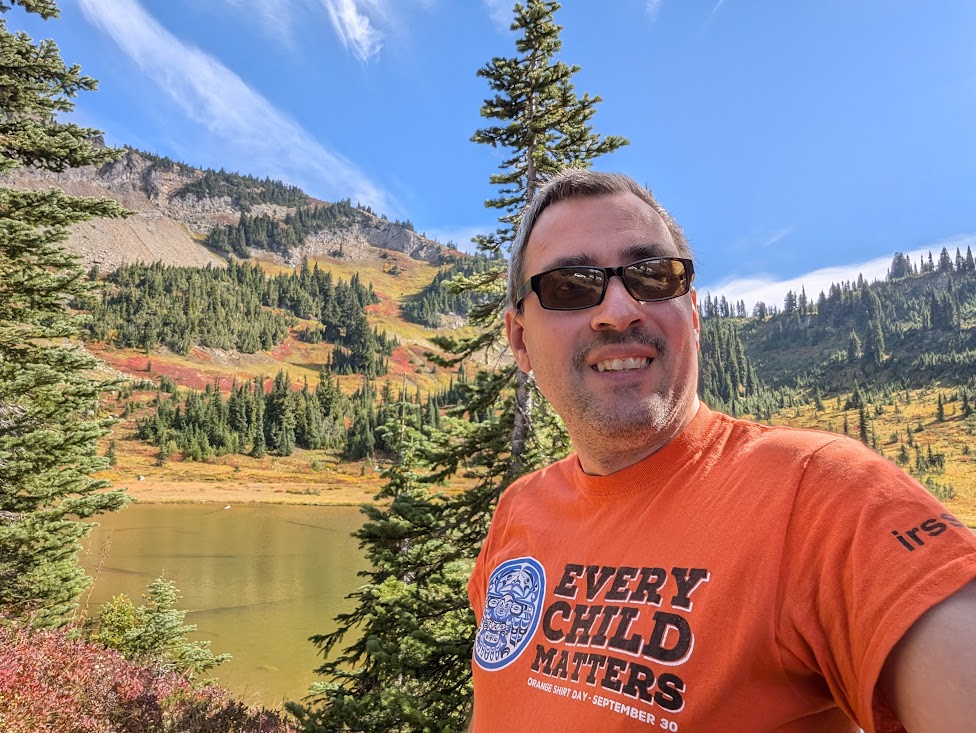

As I sit down to write about Orange Shirt Day and the National Day for Truth and Reconciliation after visiting Mt. Rainier National Park in the US, I’m struck by how much this commemoration has grown and evolved, not just in Canada but in my own understanding and approach to it.
When I first wrote about Orange Shirt Day in 2020 (https://krasun.ca/2020/10/01/orange-shirt-faith-hope-love-wisdom-and-more-about-september-30-day/), I found myself drawing unexpected connections. September 30th wasn’t just about the painful history of residential schools in Canada; it also coincided with the Ukrainian day of Mother Sophia (Wisdom) and her daughters Faith, Hope, and Love. This intersection of commemorations led me to reflect on the universality of children’s experiences in the face of systemic injustice.
I thought about the stories I’d heard from my Indigenous students who survived Canada’s residential school system, and how they echoed stories from Ukraine about children in “internats” and Ukrainian-Canadians in boarding schools. Each story was unique, yet they all shared themes of loss – loss of love, culture, family, language, and home. Each survivor had their own “orange shirt” taken away, whether it was literally a piece of clothing or metaphorically their sense of identity and belonging.
As I continued to write about this day in 2021 (https://krasun.ca/2021/09/25/national-day-for-truth-and-reconciliation-events-and-educational-resources%e2%80%af/) and 2022 (https://krasun.ca/2022/09/29/2022-national-day-for-truth-and-reconciliation-events-educational-and-business-resources/), I saw how the commemoration was growing. My posts evolved from personal reflections to comprehensive lists of events, resources, and even Indigenous-owned businesses to support. This evolution mirrored the growing recognition of this day in Canada, and the increasing efforts to provide meaningful ways for people to engage with its message.
Now, as I write in 2024, I’m thinking about how the message of “every child matters” extends far beyond Canada’s borders. Every country has its own history of injustice towards children, its own need for truth and reconciliation. I’m reminded of the various national days I’ve encountered in my travels:
- In Ukraine, the Day of Remembrance of the Victims of the Holodomor could be a time to honour the children lost to the human-made famine.
- In the United States, Native American Heritage Month could include a day dedicated to acknowledging the impact of boarding schools on Indigenous children.
- Spain’s Day of the Spanish Constitution could be an opportunity to reconcile with the impact of the Franco era on children from Republican families.
- Portugal’s Freedom Day could expand to confront the colonial past and its effects on children in former colonies.
- Norway’s Sami National Day could acknowledge the harm done to Sami children through forced assimilation policies.
- Panama’s Day of the Black Ethnicity could address the historical discrimination faced by Afro-Panamanian and indigenous children.
Each of these days, like Orange Shirt Day in Canada, could be adapted to create space for acknowledging painful truths, honouring survivors and their descendants, educating younger generations, and committing to ongoing reconciliation efforts.
As I reflect on my years of writing about Orange Shirt Day, I’m struck by how a single story – Phyllis Webstad’s orange shirt – has sparked a national movement in Canada. It makes me wonder: what stories are waiting to be told in other countries? What symbols of childhood innocence lost could become rallying points for truth and reconciliation elsewhere?
This year, as we observe the National Day for Truth and Reconciliation in Canada, I want to extend an invitation to people around the world: consider how the message that “every child matters” applies in your own national context. What histories need to be acknowledged? What truths need to be told? What reconciliation efforts are needed?
The journey of reconciliation is ongoing, and it looks different in every country. But at its heart, it’s always about acknowledging past harms, particularly those inflicted on the most vulnerable – our children – and committing to building a more just future.
As we wear orange shirts in Canada, let’s remember that every child, in every country, at every point in history, matters. And let’s consider how we can adapt our national commemorations to reflect this truth, creating powerful catalysts for healing and progress towards a more just society for all children, everywhere.
Leave a Reply