
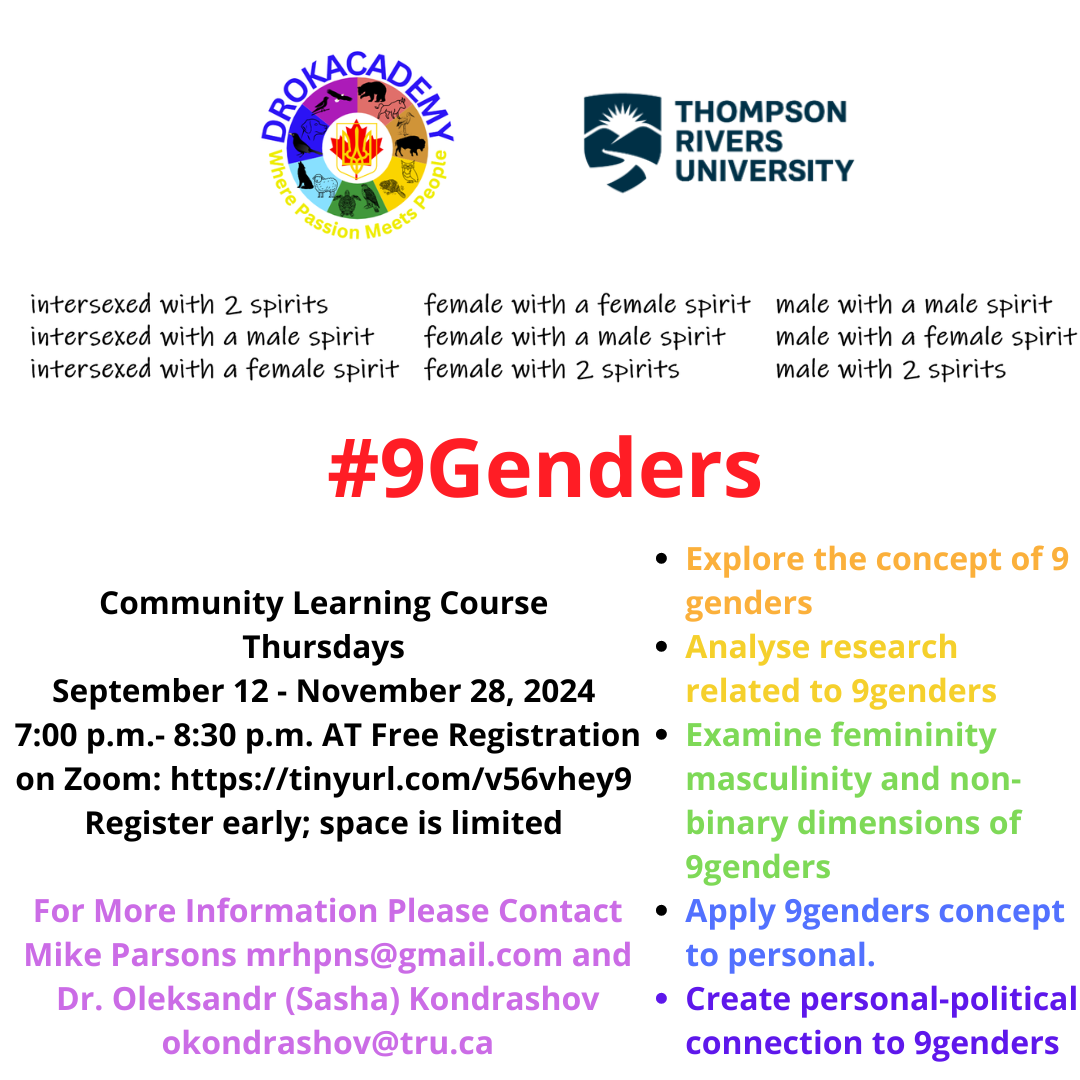

This event took place from September 12, 2024 to November 28, 2024.
Delve into the complexities of gender with our innovative 9Genders course. This free, community-focused learning experience invites you to expand your understanding of gender beyond traditional binaries using Mike Parsons ancestral 9Genders teachings.
9Genders Community Learning Course
🗓️ Thursdays, September 12 – November 28, 2024
🕖 7:00 p.m. – 8:30 p.m. AT
💻 Via Zoom
Free Registration: https://tinyurl.com/mrxst36m
🚨 Register early – space is limited!
Course Objectives:
- Explore the 9Genders Concept: Gain a comprehensive understanding of gender diversity beyond traditional models.
- Analyze Current Research: Engage with cutting-edge studies and theories related to the 9Genders framework.
- Examine Gender Dimensions: Investigate femininity, masculinity, and non-binary aspects within the 9Genders concept.
- Personal Application: Apply the 9Genders concept to your own experiences and understanding of gender.
- Create Personal-Political Connections: Explore how the 9Genders framework intersects with broader social and political issues.
Who Should Attend:
- Students of social work and gender studies, sociology, psychology, and related fields
- Educators and researchers interested in gender theory
- LGBTQ+ community members and allies
- Healthcare professionals working with diverse gender identities
- Anyone curious about expanding their understanding of gender
Why This Course Matters:
- Gain a nuanced understanding of gender diversity
- Challenge traditional gender paradigms
- Develop a framework for more inclusive practices in various fields
- Contribute to ongoing discussions about gender in society
- Reflect on personal experiences and identities within a broader context
This course offers a unique opportunity to engage with innovative concepts in social work and gender studies, fostering both personal growth and community understanding.
Course Description
This course provides an introduction to 9Genders, an Ancestoral framework for understanding gender that encompasses nine categories. Students will learn about the history and cultural foundations of 9Genders, key terminology related to gender identity, expression and spirituality, as well as intersections with concepts like masculinity, femininity and non-binary identities. The course incorporates Ancestral research methods and ceremonies for a holistic and spiritually-grounded learning experience.
Learning Objectives
By the end of this course, students will be able to:
- Explain the 9Genders framework and describe each of the nine gender categories
- Define key terminology related to gender identity, gender expression, sexual orientation, spirituality and Ancestral concepts of gender
- Discuss how masculinity and femininity show up in Ancestral cultures and their impacts
- Identify non-binary gender identities and explain their significance in local communities
- Apply Ancestral research methods ethically and respectfully, including conducting research within ceremony
- Reflect on their own gender identity, spirituality and expression through an Ancestral cultural lens
- Demonstrate cultural humility and openness in learning about diverse gender identities and experiences
Course Schedule
| Weekly Topics | Readings |
| Week 1: Introduction to 9Genders | The Nine Genders, A Reintroduced Indigenous Way Of Organizing Gender https://www.youtube.com/watch?v=5p_C3jtvk9c A map of gender-diverse cultures https://www.pbs.org/independentlens/content/two-spirits_map-html/ Kumu Hina | Full Documentary | LGBTQIA+ https://www.youtube.com/watch?v=uruiON99Vc4&ab_channel=PrideCentral He Inoa Mana (A powerful name) | Hinaleimoana Wong-Kalu (Kumu Hina) | TEDxMaui https://www.youtube.com/watch?v=A5nQZ7_ApM4 Nanda, S. (2008). Cross-cultural issues. Handbook of sexual and gender identity disorders, 457-486. Wikipedia Article on Third Gender https://en.wikipedia.org/wiki/Third_gender Chen, J. S. (2007). A Vision of Multiple Genders: Cross-cultural Learning in Asian Countries from Images of Kuan Yin and” Bishonen” 1. Journal of Cultural Research in Art Education, 25, 91. |
| Week 2 Gender Terminology | 47 Terms That Describe Sexual Attraction, Behavior, and Orientation https://www.bu.edu/diversity/resource-toolkit/47-terms-that-describe-sexual-attraction-behavior-and-orientation/ Pilcher, J., & Whelehan, I. (2016). 50 key concepts in gender studies. Sage. https://6rang.org/wp-content/uploads/2013/06/PanjahMafhomeKelidiMotaleateGenderi.pdf Wikipedia Article on Gender: https://en.wikipedia.org/wiki/Gender 68 Terms That Describe Gender Identity and Expression https://www.healthline.com/health/different-genders |
| Week 3: Spirituality and Gender | Becoming Two-Spirit Brian Joseph Gilley https://transreads.org/wp-content/uploads/2022/01/2022-01-13_61e06e72ab1b0_BecomingTwo-SpiritGayIdentityandSocialAcceptanceinIndianCountrybyBrianJosephGilleyz-lib.org_.pdf Jolivette, A. J. (2016). Indian Blood: HIV and Colonial Trauma in San Francisco’s Two-Spirit Community. University of Washington Press. https://uwapress.uw.edu/book/9780295998503/indian-blood/ |
| Week 4: Masculinity Dimension of Gender | Harrington, C. (2021). What is “toxic masculinity” and why does it matter?. Men and Masculinities, 24(2), 345-352. Waling, A. (2019). Problematising ‘toxic’and ‘healthy’masculinity for addressing gender inequalities. Australian Feminist Studies, 34(101), 362-375. Courtenay, W. H. (2000). Constructions of masculinity and their influence on men’s well-being: a theory of gender and health. Social science & medicine, 50(10), 1385-1401. Innes, R.A. Anderson, K (2014). Indigenous Men and Masculinities: Legacies, Identities, Regeneration. University of Manitoba Press Tengan, T. K. (2002). (En) gendering colonialism: masculinities in Hawai’i and Aotearoa. Cultural Values, 6(3), 239-256. |
| Week 5: Femininity Dimension of Gender | McCann, H. (2022). Is there anything “toxic” about femininity? The rigid femininities that keep us locked in. Psychology & Sexuality, 13(1), 9-22. Starblanket, G. (2020). Transforming the Gender Divide? Deconstructing Femininity and Masculinity in Indigenous Politics. Turbulent Times, Transformational Possibilities?: Gender and Politics Today and Tomorrow, 121. |
| Week 6: Non-binary Dimension of Gender | Barker, M. J., & Richards, C. (2015). Further genders. In The Palgrave handbook of the psychology of sexuality and gender (pp. 166-182). Palgrave Macmillan, London. Robinson, M. (2019). Two-spirit identity in a time of gender fluidity. Journal of Homosexuality. Richards, C., Bouman, W. P., Seal, L., Barker, M. J., Nieder, T. O., & T’Sjoen, G. (2016). Non-binary or genderqueer genders. International Review of Psychiatry, 28(1), 95-102. Matsuno, E., & Budge, S. L. (2017). Non-binary/genderqueer identities: A critical review of the literature. Current Sexual Health Reports, 9(3), 116-120. Hunt, S. (2018). Embodying self-determination: beyond the gender binary. Determinants of Indigenous peoples’ health, 22-39. Ashley, F. (2021). ‘X’Why? Gender Markers and Non-binary Transgender People. In Trans Rights and Wrongs (pp. 33-48). Springer, Cham. |
| Week 7: Research within Ceremony and 9Genders | Wilson, S. (2020). Research in ceremony: Indigenous research methods. Fernwood publishing. Nilson, C. (2017). A journey toward cultural competence: The role of researcher reflexivity in indigenous research. Journal of Transcultural Nursing, 28(2), 119-127. Fitzmaurice, K. (2011). Transgressing the Boundaries of Native Studies: Traces of’White Paper’Policy in Academic Patterns of Indigenization. The Canadian Journal of Native Studies, 31(2), 63. Craft, A. (2016). Giving and receiving life from Anishinaabe nibi inaakonigewin (our water law) research. In Methodological challenges in nature-culture and environmental history research (pp. 125-139). Routledge. |
| Week 8: Guest Presentation 1: Selected Topics or Teaching about Gender | Selected chapters from Stahly, G. B. (2007). Gender identity, equity, and violence: Multidisciplinary perspectives through service learning. Stylus Publishing, LLC.. |
| Week 9: Guest Presentation 2: Selected Topics | Selected chapters from Singh, A. A. (2018). The queer and transgender resilience workbook: Skills for navigating sexual orientation and gender expression. New Harbinger Publications. |
| Week 10: Guest Presentation 3: Selected Topics | |
| Week 11: Guest Presentation 4: Selected Topics | |
| Week 12: Course Review |
Guest/ Group Presentation Ideas:
Ancestral Concepts of Family and Kinship
Explore how gender roles and identities shape family structures, child-rearing practices, kinship bonds in different Ancestral communities.
Gender and Spirituality
Provide examples of third/non-binary gender identities holding specific spiritual roles in Ancestral cultures. Discuss spiritual teachings around gender fluidity.
Gender Representation in Indigenous Media
Analyze portrayals and representations of masculine, feminine and non-binary identities across Indigenous film, literature, art.
Gendered Violence and Activism
Shed light on epidemic rates of violence against Indigenous women, girls and two-spirit people. Highlight activism efforts and solutions.
Gender Roles in Ceremonies
Outline the different responsibilities, rituals, symbols and regalia that women, men and two-spirit community members hold in sacred ceremonies.
Resilience and Wellbeing
Share therapeutic practices, self-care tools and community supports available to foster resilience among Indigenous LGBTQIA2S+ and non-binary people.
Language and Gender
Explore how Indigenous languages encode and express concepts of gender compared to English/colonial languages. Provide vocabulary examples.
Storytelling and Oral Traditions
Tell traditional stories and oral histories that portray gender identity and teach lessons related to masculinity, femininity or non-binary experiences.
Nádleehi and Dilbaa – Exploring Navajo Gender Diversity
Dive deeper into Navajo Nádleehi and Dilbaa identities that blend masculine and feminine spirit.
Māhū – The Honored Third Gender of Hawaii
Learn about the Māhū, who embody both male and female spirit and hold respected roles in Hawaiian culture.
The Âîâba Wewena – The Two-Spirit Identity Among First Nations
Define the Âîâba Wewena label used across many First Nations communities to describe non-binary Indigenous people.
Hijra – South Asia’s Third Gender Culture
Examine beliefs about the Hijra, who are seen as blessed in Hindu/South Asian traditions and confer luck at weddings/births.
Fa’afafine – Samoa’s Gender Limitless Culture
Explore Fa’afafine identity in Samoan culture, where gender exists on a fluid continuum vs. a male/female binary.
Alternate Genders in Ancient Cultures
Research gender diversity in antiquity, such as Galli priests, Norse Seiðr, Albanian Burrnesha sworn virgins.
Genetics, Intersex Realities and Gender
Discuss scientific evidence on sex variation and how concepts of gender/sex are socially constructed vs. biologically fixed.
Gender Identity Across the Lifespan
Compare gender development milestones for children, youth questioning gender, elders embracing ancestral wisdom.
Thailand’s Kathoey and Indigenous Poo-Ying
Learn about the Kathoey third gender identity and Poo-Ying role held by Thai transgender women.
Gender Transformation in Native American Beliefs
Discuss spiritual stories of gender shifting – the nádleehí in Navajo culture, Ihamana Zuni two-spirits.
Calabai and Calalai in Indonesia’s Bugis Culture
Study the ancient Calabai and Calalai identities in Sulawesi that blend femininity and masculinity.
Māhū of Tahiti and Maori Takatāpui
Explore Māhū in Tahiti and takatāpui in Māori culture – similar paradigms of non-binary genders.
Two-Spirit Perspectives on Environment and Nature
Present Indigenous two-spirit philosophies of human interconnection with ecosystems and wildlife.
Gender Complexity in Ancient Europe and Africa
Research historic same-sex marriages, ‘cross-dressing’ warriors, and third/neutral gender roles on these continents.