
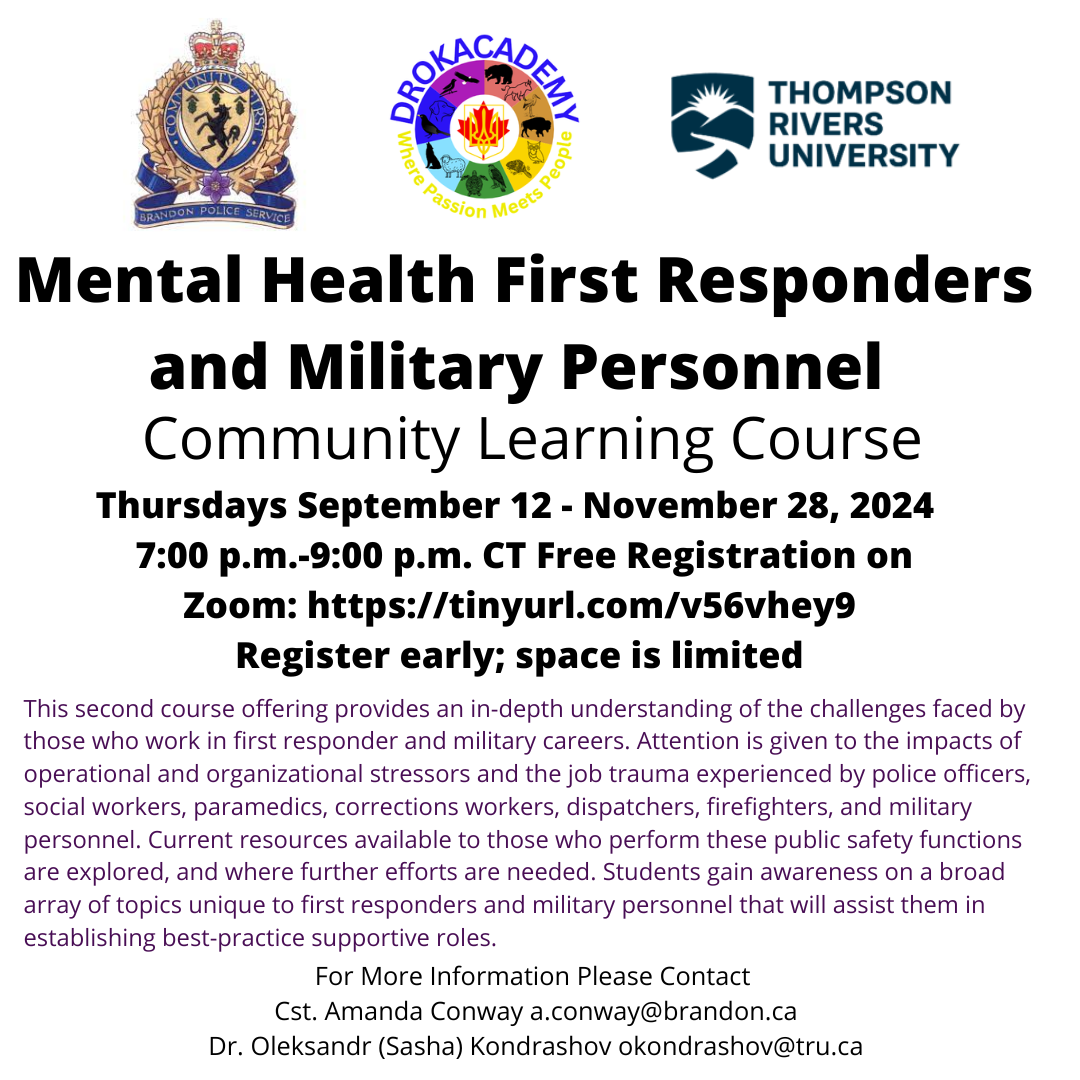

This event took place from September 12, 2024 to November 28, 2024.
Join a groundbreaking course designed for first responders, military personnel, social workers, clinicians, mental health professionals, and concerned citizens. Gain crucial insights into the unique mental health challenges faced by these vital community members.
Mental Health for First Responders and Military Personnel
🗓️ Thursdays, September 12 – November 28, 2024
🕖 7:00 p.m. – 9:00 p.m. CT
💻 Via Zoom
Free Registration: https://tinyurl.com/v56vhey9
🚨 Register early – space is limited!
Who Should Attend:
- First Responders (police officers, firefighters, paramedics, dispatchers, corrections workers)
- Military Personnel
- Social Workers
- Clinicians working with or interested in working with first responders or military personnel
- Mental Health Professionals
- Community members
Why This Course Matters:
- Understand Unique Challenges: Gain deep insights into the mental health issues specific to first responders and military roles.
- Address Real Issues: Explore impacts of work-related stress, organizational pressures, and exposure to traumatic situations.
- Enhance Clinical Skills: For clinicians, develop specialized knowledge to better serve these populations.
- Discover Support Systems: Learn about available resources and identify areas needing improvement.
- Develop Supportive Strategies: Acquire practical skills to support first responders and military personnel in your practice or community.
Making a Broader Impact:
- Textbook Creation: Contribute to a comprehensive resource on mental health for first responders in Canada.
- Public Awareness: Help educate the wider community about the mental health needs of these professionals.
- Advocacy: Join the effort to advocate for adequate mental health supports.
Weekly Topics:
Week 1: The Human Behind the Uniform: Understanding First Responder and Military Personnel Mental Health
Overview: Introduction to mental health challenges faced by first responders and military personnel. Explore common disorders like PTSD, depression, and anxiety in this population.
Readings from the first offering of the course:
Emergency Responders: Tips for taking care of yourself
https://emergency.cdc.gov/coping/responders.asp
Kleim, B., & Westphal, M. (2011). Mental health in first responders: A review and recommendation for prevention and intervention strategies. Traumatology, 17(4), 17-24. Link: https://bit.ly/3JqvYzm
Mental Health Disorders and Symptoms in Military and First Responders
Andrews, K. L., Jamshidi, L., Nisbet, J., Teckchandani, T. A., Price, J. A. B., Ricciardelli, R., Anderson, G. S., & Carleton, R. N. (2022). Mental Health Disorder Symptoms among Canadian Coast Guard and Conservation and Protection Officers. International Journal of Environmental Research and Public Health, 19(23). https://doi.org/10.3390/ijerph192315696
Carleton, R. N., Afifi, T. O., Taillieu, T., Turner, S., Krakauer, R., Anderson, G. S., MacPhee, R. S., Ricciardelli, R., Cramm, H. A., Groll, D., & McCreary, D. R. (2019). Exposures to potentially traumatic events among public safety personnel in Canada. Canadian Journal of Behavioural Science, 51(1), 37–52. https://doi.org/10.1037/cbs0000115
Chui, Z., Fear, N. T., Greenberg, N., Jones, N., Jones, E., & Goodwin, L. (2022). Combat exposure and co-occurring mental health problems in UK Armed Forces personnel. Journal of Mental Health, 31(5), 624–633. https://doi.org/10.1080/09638237.2020.1766666
Clark, L. V., Fida, R., Skinner, J., Murdoch, J., Rees, N., Williams, J., Foster, T., & Sanderson, K. (2021). Mental health, well-being and support interventions for UK ambulance services staff: an evidence map, 2000 to 2020. British Paramedic Journal, 5(4), 25–39. https://doi.org/10.29045/14784726.2021.3.5.4.25
Finnegan A, Randles R. (2023). Prevalence of common mental health disorders in military veterans: using primary healthcare data. BMJ Military Health, 169, 523–528. doi:10.1136/bmjmilitary-2021-002045
Jones, S. (2017). Describing the mental health profile of first responders: A systematic review. Journal of the American Psychiatric Nurses Association, 23(3), 200–214. https://doi.org/10.1177/1078390317695266
Maglione, M. A., Chen, C., Bialas, A., Motala, A., Chang, J., Akinniranye, O., & Hempel, S. (2022). Combat and Operational Stress Control Interventions and PTSD: A Systematic Review and Meta-Analysis. Military Medicine, 187(7/8), e846–e855. https://doi.org/10.1093/milmed/usab310
Murphy, D., Ashwick, R., Palmer, E., & Busuttil, W. (2019). Describing the profile of a population of UK veterans seeking support for mental health difficulties. Journal of Mental Health, 28(6), 654–661. https://doi.org/10.1080/09638237.2017.1385739
Osório, C., Jones, N., Jones, E., Robbins, I., Wessely, S., & Greenberg, N. (2018). Combat Experiences and their Relationship to Post-Traumatic Stress Disorder Symptom Clusters in UK Military Personnel Deployed to Afghanistan. Behavioral Medicine, 44(2), 131–140. https://doi.org/10.1080/08964289.2017.1288606
Robinson, M., McGlinchey, E., & Armour, C. (2023). ICD-11 complex post-traumatic stress disorder and psychiatric comorbidity among UK Armed Forces veterans in Northern Ireland: a latent class analysis. European Journal of Psychotraumatology, 14(2), 1–13. https://doi.org/10.1080/20008066.2023.2212551
Vyas, K., Murphy, D., & Greenberg, N. (2023). Cognitive biases in military personnel with and without PTSD: a systematic review. Journal of Mental Health, 32(1), 248–259. https://doi.org/10.1080/09638237.2020.1766000
Wagner, S. L., White, N., Regehr, C., White, M., Alden, L. E., Buys, N., Carey, M. G., Corneil, W., Fyfe, T., Matthews, L. R., Randall, C., Krutop, E., & Fraess-Phillips, A. (2020). Ambulance personnel: Systematic review of mental health symptoms. Traumatology, 26(4), 370–387. https://doi.org/10.1037/trm0000251
Week 2: Unpacking the Culture: Police Psychology, Implicit Bias, and Embracing Diversity
Overview: Examine police culture, personality traits, and psychological challenges. Discuss gender issues and the importance of diversity in law enforcement.
Readings from the first offering of the course:
Bradford, B., Jackson, J., & Hough, M. (2013). Police legitimacy in action: Lessons for theory and practice. Link: https://papers.ssrn.com/sol3/papers.cfm?abstract_id=2236691
Gender and Diversity Issues in Military and First Responder Mental Health
Godier, M. L. R., Gillin, N., & Fossey, M. J. (2022). “Treat everyone like they’re a man”: Stakeholder perspectives on the provision of health and social care support for female veterans in the UK. Health & Social Care in the Community, 30(6), e3966–e3976. https://doi.org/10.1111/hsc.13790
Godier-McBard, L. R., Gillin, N., & Fossey, M. (2021). We Also Served: The Health and Well-being of Female Veterans in the UK. Anglia Ruskin Research Online (ARRO). https://hdl.handle.net/10779/aru.23783757.v1
Lane, R., Gribble, R., Alves-Costa, F., Taylor, A., Howard, L. M., Fear, N. T., & MacManus, D. (2024). Intimate Partner Violence and Abuse: A Qualitative Exploration of UK Military Personnel and Civilian Partner Experiences. Journal of Family Violence, 39(2), 285–301. https://doi.org/10.1007/s10896-022-00446-x
Lane, R., Alves-Costa, F., Gribble, R., Taylor, A., Howard, L. M., Fear, N. T., & MacManus, D. (2024). Help-seeking for Intimate Partner Violence and Abuse: Experiences of Serving and Ex-serving UK Military Personnel. Journal of Family Violence, 39(4), 595–611. https://doi.org/10.1007/s10896-023-00534-6
Poole, M. N. (2021). Women Veterans of the Canadian Armed Forces and Royal Canadian Mounted Police: A scoping review. Journal of Military, Veteran & Family Health, 7, 6–18. https://doi.org/10.3138/jmvfh-2021-0020
Week 3 “Occupational Pressures: Stress, Vicarious Trauma, and Resilience in Emergency Services”
Overview: Analyze occupational stressors, their impact on well-being, and organizational policies affecting first responders’ mental health.
Readings from the first offering of the course:
First Responder Mental Health: It’s Not All In The Mind
Cohen, I. M., McCormick, A. V., & Rich, B. (2019). Creating a culture of police officer wellness. Policing: A Journal of Policy and Practice, 13(2), 213-229.
Occupational Stress and Well-being
Bonita, I., Halabicky, O. M., & Liu, J. (2024). Exposure to Wildfires Exposures and Mental Health Problems among Firefighters: A Systematic Review. Atmosphere, 15(1), 78. https://doi.org/10.3390/atmos15010078
Brasher, K. S., Sparshott, K. F., Weir, A. B. C., Day, A. J., & Bridger, R. S. (2012). Two year follow-up study of stressors and occupational stress in submariners. Occupational Medicine, 62(7), 563–565. https://doi.org/10.1093/occmed/kqs104
Bridger, R. S., Kilminster, S., & Slaven, G. (2007). Occupational stress and strain in the naval service: 1999 and 2004. Occupational Medicine, 57(2), 92–97. https://doi.org/10.1093/occmed/kql124
Gottschall, S., & Guerin, E. (2023). Organizational and non-organizational risk and resilience factors associated with mental health and well-being in the Royal Canadian Navy. Current Psychology, 42(8), 6179–6193. https://doi.org/10.1007/s12144-021-01508-x
Hird, K., & Richardson, C. (2023). Exploring the experiences of community first responders working in a UK ambulance service. British Paramedic Journal, 7(4), 8–13. https://doi.org/10.29045/14784726.2023.3.7.4.8
Irizar, P., Gage, S. H., Fallon, V., & Goodwin, L. (2022). A latent class analysis of health risk behaviours in the UK Police Service and their associations with mental health and job strain. BMC Psychiatry, 22(1), 426. https://doi.org/10.1186/s12888-022-04054-3
Lamb, D., & Withnall, R. D. (2021). A qualitative study to investigate the psychosocial effects of operational deployments on Medical Emergency Response Team personnel. Stress & Health: Journal of the International Society for the Investigation of Stress, 37(2), 364–377. https://doi.org/10.1002/smi.3001
Payne, N., & Kinman, G. (2019). Job demands, resources and work-related well-being in UK firefighters. Occupational Medicine, 69(8–9), 604–609. https://doi.org/10.1093/occmed/kqz167
Reis Coimbra, M. A., Aparecida Ferreira, L., & Alves Araújo, A. P. (2020). Impacts of stress on occupational exposure of firefighters: an integrative review. UERJ Nursing Journal, 28, 1–8. https://doi.org/10.12957/reuerj.2020.52825
Wolffe, T. A. M., Robinson, A., Clinton, A., Turrell, L., & Stec, A. A. (2023). Mental health of UK firefighters. Scientific Reports, 12(1), 1–12. https://doi.org/10.1038/s41598-022-24834-x
Week 4 “ Confronting Trauma: Moral Injury, PTSD, and Ethical Challenges in the Field”
Overview: Explore trauma exposure, Post-Traumatic Stress Injury (PTSI), and ethical dilemmas faced by first responders.
Readings from the first offering of the course:
Emotional Survival for First Responders and Military Personnel (Law Enforcement) – Dr. Gilmartin
Trauma Exposure and Moral Injury
Bricknell M. (2021). Military Combat Mental Health Framework. BMJ Military Health, 167(3).
Declercq, F., Meganck, R., Deheegher, J., & Van Hoorde, H. (2011). Frequency of and subjective response to critical incidents in the prediction of PTSD in emergency personnel. Journal of Traumatic Stress, 24(1), 133–136. https://doi.org/10.1002/jts.20609
Grenier, S. (2018). After the War: Surviving PTSD and Changing Mental Health Culture. U of R Press.
Houle, S. A., Vincent, C., Jetly, R., & Ashbaugh, A. R. (2021). Patterns of distress associated with exposure to potentially morally injurious events among Canadian Armed Forces service members and Veterans: A multi-method analysis. Journal of Clinical Psychology, 77(11), 2668–2693. https://doi.org/10.1002/jclp.23205
Nazarov, A., Fikretoglu, D., Liu, A., Thompson, M., & Zamorski, M. A. (2018). Greater prevalence of post-traumatic stress disorder and depression in deployed Canadian Armed Forces personnel at risk for moral injury. Acta Psychiatrica Scandinavica, 137(4), 342–354. https://doi.org/10.1111/acps.12866
Racine, E., Cioaba, I. M., & Boehlen, W. (2023). Ethical aspects of the work conditions of public safety personnel: a need for attention and solidarity. Canadian Journal of Public Health, 114(3), 502–506. https://doi.org/10.17269/s41997-023-00744-x
Rodrigues, S., Mercier, J.-M., McCall, A., Nannarone, M., & Hosseiny, F. (2023). “Against everything that got you into the job”: experiences of potentially morally injurious events among Canadian public safety personnel. European Journal of Psychotraumatology, 14(2), 1–13. https://doi.org/10.1080/20008066.2023.2205332
Skryabina, E. A., Betts, N., Amlôt, R., & Reedy, G. (2021). Understanding the psychological impacts of responding to a terrorist incident. European Journal of Psychotraumatology, 12(1), 1–11. https://doi.org/10.1080/20008198.2021.1959116
Week 5 “Under Public Eye: Navigating Social Media, Public Scrutiny, and Family Support in the Digital Age”
Overview: Discuss the impact of public scrutiny and social media on first responders and military personnel. Explore the crucial role of family and social support.
Readings from the first offering of the course:
Social Workers to the Rescue?: An Ur o the Rescue?: An Urgent Call for Emer gent Call for Emergency Response Reform
Tucker, J. M., Bratina, M. P., & Caprio, B. (2022). Understanding the effect of news media and social media on first responders. Crisis, Stress, and Human Resilience: An International Journal, 3(4), 106-137. Link: https://www.crisisjournal.org/article/33611.pdf
Family and Social Support
Gribble, R., & Fear, N. T. (2022). Living separately during the week: Influences on family functioning, health, and well-being of UK naval families. Journal of Military, Veteran and Family Health, 8(2), 82–93. https://doi.org/10.3138/jmvfh-2021-0062
Hatch, S. L., Harvey, S. B., Dandeker, C., Burdett, H., Greenberg, N., Fear, N. T., & Wessely, S. (2013). Life in and after the armed forces: Social networks and mental health in the UK military. Sociology of Health & Illness, 35(7), 1045–1064. https://doi.org/10.1111/1467-9566.12022
Hill, S., Williams, A., Khalid-Khan, S., Reddy, P., Groll, D., Rühland, L., & Cramm, H. (2023). Mental Health of Canadian Military-Connected Children: A Qualitative Study Exploring the Perspectives of Service Providers. Journal of Child & Family Studies, 32(11), 3447–3458. https://doi.org/10.1007/s10826-022-02450-7
Mahar, A. L., Cramm, H., King, M., King, N., Craig, W. M., Elgar, F. J., & Pickett, W. (2023). A cross-sectional study of mental health and well-being among youth in military-connected families. Health Promotion and Chronic Disease Prevention in Canada, 43(6), 290–298. https://doi.org/10.24095/hpcdp.43.6.03
O’Toole, M., Mulhall, C., & Eppich, W. (2022). Breaking down barriers to help-seeking: preparing first responders’ families for psychological first aid. European Journal of Psychotraumatology, 13(1), 1–8. https://doi.org/10.1080/20008198.2022.2065430
Sharp, M.-L., Solomon, N., Harrison, V., Gribble, R., Cramm, H., Pike, G., & Fear, N. T. (2022). The mental health and wellbeing of spouses, partners and children of emergency responders: A systematic review. PLoS ONE, 17(6), 1–23. https://doi.org/10.1371/journal.pone.0269659
Tjin, A., Traynor, A., Doyle, B., Mulhall, C., Eppich, W., & O’Toole, M. (2022). Turning to “Trusted Others”: A Narrative Review of Providing Social Support to First Responders. International Journal of Environmental Research and Public Health, 19(24). https://doi.org/10.3390/ijerph192416492
Williams, A., Cramm, H., Khalid-Khan, S., Reddy, P., Groll, D., Rühland, L., & Hill, S. (2024). Mental Health of Canadian Children Growing Up in Military Families: The Child Perspective. Armed Forces & Society, 50(2), 362–382. https://doi.org/10.1177/0095327X221128837
Week 6 “ Maintaining Balance: Emotional Coping Strategies, Biofeedback, and Adaptive Mechanisms for First Responders”
Overview: Delve into coping strategies and emotional resilience techniques for all first responders.
Readings from the first offering of the course:
First Responder Mental Health: It’s Not All In The Mind
Cohen, I. M., McCormick, A. V., & Rich, B. (2019). Creating a culture of police officer wellness. Policing: A Journal of Policy and Practice, 13(2), 213-229.
Organizational Factors and Mental Health Policies
Boehme, B. A. E., Shields, R. E., Asmundson, G. J. G., Szeto, A. C. H., Dobson, K. S., & Carleton, R. N. (2024). A short version of the Opening Minds Scale–Workplace Attitudes: Factor structure and factorial validity in a sample of Canadian public safety personnel. Canadian Journal of Behavioral Science, 56(2), 157–162. https://doi.org/10.1037/cbs0000350
Carleton, R. N. (2021). Collaborating to Support the Mental Health of Public Safety Personnel: The Canadian Institute for Public Safety Research and Treatment. Canadian Psychology, 62(2), 167–173. https://doi.org/10.1037/cap0000267
Du, B. B., Yung, M., Gruber, J., & Yazdani, A. (2022). Organizational strategies to address posttraumatic stress injuries among Canadian paramedics. Work, 72(3), 1035–1045. https://doi.org/10.3233/WOR-210614
Edgelow, M., Scholefield, E., McPherson, M., Legassick, K., & Novecosky, J. (2022). Organizational Factors and Their Impact on Mental Health in Public Safety Organizations. International Journal of Environmental Research and Public Health, 19(21). https://doi.org/10.3390/ijerph192113993
Fisher, M. P., & Lavender, C. D. (2023). Ensuring Optimal Mental Health Programs and Policies for First Responders: Opportunities and Challenges in One U.S. State. Community Mental Health Journal, 59(7), 1341–1351. https://doi.org/10.1007/s10597-023-01121-1
Marcus, N., & Stergiopoulos, V. (2022). Re‐examining mental health crisis intervention: A rapid review comparing outcomes across police, co‐responder and non‐police models. Health & Social Care in the Community, 30(5), 1665–1679. https://doi.org/10.1111/hsc.13731
Marsden, M., Nigam, J., Lemetyinen, H., & Edge, D. (2020). Investigating police officers’ perceptions of their role in pathways to mental healthcare. Health & Social Care in the Community, 28(3), 913–921. https://doi.org/10.1111/hsc.12922
Neal, L. A., Kiernan, M., Hill, D., McManus, F., & Turner, M. A. (2003). Management of mental illness by the British army. The British Journal of Psychiatry, 182(4), 337–341. https://doi.org/10.1192/bjp.182.4.337
Week 7 “ Transitioning Roles: Peer Support and Mental Health in Military, RCMP, and Veteran Communities”
Overview: Examine mental health challenges specific to military and RCMP personnel, including the transition to civilian life for veterans.
Readings from the first offering of the course:
Olson, M. D. (2018). Exploring military social work from a social justice perspective. International Social Work, 61(1), 119-129.
Blackburn, D. (2016). Transitioning from military to civilian life: Examining the final step in a military career. Canadian Military Journal, 16(4), 53-61.Link: https://bit.ly/3Kfh148
Blackburn, D. (2015). Social Work in the Military~ Considering a Renewed Scope of Practice. Canadian Military Journal, 16(1), 34-43.Link: https://bit.ly/3j7NIVr
Smith-MacDonald, L., VanderLaan, A., Kaneva, Z., Voth, M., Pike, A., Jones, C., & Bremault-Phillips, S. (2022). “Putting Down and Letting Go”: An Exploration of a Community-Based Trauma-Oriented Retreat Program for Military Personnel, Veterans, and RCMP. Trauma Care, 2(2), 95-113. Link: https://www.mdpi.com/2673-866X/2/2/9/pdf
Mental Health of Veterans and Transition to Civilian Life
Buckman, J. E. J., Forbes, H. J., Clayton, T., Jones, M., Jones, N., Greenberg, N., Sundin, J., Hull, L., Wessely, S., & Fear, N. T. (2013). Early Service leavers: a study of the factors associated with premature separation from the UK Armed Forces and the mental health of those that leave early. European Journal of Public Health, 23(3), 410–415. https://doi.org/10.1093/eurpub/cks042
Coulthard, J., Sudom, K., & Born, J. (2022). Predictors of self-reported health and psychological distress among recently released Canadian Armed Forces Veterans. Military Psychology, 34(6), 722–731. https://doi.org/10.1080/08995605.2022.2057789
Diehle, J., Williamson, V., & Greenberg, N. (2021). Out of sight out of mind: an examination of mental health problems in UK military reservists and veterans. Journal of Mental Health, 30(5), 601–606. https://doi.org/10.1080/09638237.2019.1581348
Weir, B., Cunningham, M., Abraham, L., & Allanson-Oddy, C. (2019). Military veteran engagement with mental health and well-being services: a qualitative study of the role of the peer support worker. Journal of Mental Health, 28(6), 647–653. https://doi.org/10.1080/09638237.2017.1370640
Williamson, V., Murphy, D., Aldridge, V., Bonson, A., Seforti, D., & Greenberg, N. (2022). Development of an intervention for moral injury-related mental health difficulties in UK military veterans: a feasibility pilot study protocol. European Journal of Psychotraumatology, 13(2), 1–12. https://doi.org/10.1080/20008066.2022.2138059
Week 8 “Behind the Scenes: Mental Health, Sleep Disorders, and Occupational Stress in Corrections and Dispatch”
Overview: Focus on the unique stressors faced by corrections officers and dispatchers. Explore sleep disorders common in these professions.
Readings from the first offering of the course:
Cone, D. C., Galante, N., & MacMillan, D. S. (2008). Can emergency medical dispatch systems safely reduce first-responder call volume?. Prehospital emergency care, 12(4), 479-485.
Kropczynski, J., Grace, R., Coche, J., Halse, S., Obeysekare, E., Montarnal, A., … & Tapia, A. (2018). Identifying actionable information on social media for emergency dispatch. Proceedings of the ISCRAM Asia Pacific, 11. Link: https://idl.iscram.org/files/jesskropczynski/2018/1672_JessKropczynski_etal2018.pdf
Sleep Disorders and Physical Health Factors
Angehrn, A., Teale Sapach, M. J. N., Ricciardelli, R., MacPhee, R. S., Anderson, G. S., & Carleton, R. N. (2020). Sleep Quality and Mental Disorder Symptoms among Canadian Public Safety Personnel. International Journal of Environmental Research and Public Health, 17(8). https://doi.org/10.3390/ijerph17082708
Brooks, S. K., & Greenberg, N. (2018). Non-deployment factors affecting psychological wellbeing in military personnel: literature review. Journal of Mental Health, 27(1), 80–90. https://doi.org/10.1080/09638237.2016.1276536
Dighton, G., Wood, K., Armour, C., Fossey, M., Hogan, L., Kitchiner, N., Larcombe, J., Rogers, R. D., & Dymond, S. (2023). Gambling problems among United Kingdom armed forces veterans: Associations with gambling motivation and posttraumatic stress disorder. International Gambling Studies, 23(1), 35–56. https://doi.org/10.1080/14459795.2022.2063923
Huang, G., Lee, T. Y., Banda, K. J., Pien, L. C., Jen, H. J., Chen, R., Liu, D., Hsiao, S. T. S., & Chou, K. R. (2022). Prevalence of sleep disorders among first responders for medical emergencies: A meta-analysis. Journal of Global Health, 12, 1–12. https://doi.org/10.7189/jogh.12.04092
Week 9 “ On the Front Lines: Cumulative Trauma, Stress, and Well-being in Firefighters and Paramedics”
Overview: Investigate the interconnected mental and physical health challenges faced by fire service and paramedic professionals.
Readings from the first offering of the course:
Crisis Intervention by Social Workers in Fire Departments: An Innovative Role for Social Workers
https://www.jstor.org/stable/23718993
A Social Work Approach: Working with EMS Providers
Special Topics in Military and First Responder Mental Health
Easterbrook, B., Brown, A., Millman, H., Van Blyderveen, S., Lanius, R., Heber, A., McKinnon, M., & O’Connor, C. (2022). The mental health experience of treatment-seeking military members and public safety personnel: a qualitative investigation of trauma and non-trauma-related concerns. Health Promotion and Chronic Disease Prevention in Canada, 42(6), 252–260. https://doi.org/10.24095/hpcdp.42.6.03
Fikretoglu, D., Sharp, M.-L., Adler, A. B., Bélanger, S., Benassi, H., Bennett, C., Bryant, R., Busuttil, W., Cramm, H., Fear, N., Greenberg, N., Heber, A., Hosseiny, F., Hoge, C. W., Jetly, R., McFarlane, A., Morganstein, J., Murphy, D., O’Donnell, M., … Pedlar, D. (2022). Pathways to mental health care in active military populations across the Five-Eyes nations: An integrated perspective. Clinical Psychology Review, 91. https://doi.org/10.1016/j.cpr.2021.102100
Ricciardelli, R., Carleton, R. N., Groll, D., & Cramm, H. (2018). Qualitatively Unpacking Canadian Public Safety Personnel Experiences of Trauma and Their Well-Being. Canadian Journal of Criminology & Criminal Justice, 60(4), 566–577. https://doi.org/10.3138/cjccj.2017-0053.r2
Thomas, V., Bizumic, B., & Quinn, S. (2023). The Occupational Moral Injury Scale: Development and validation in frontline health and first responder workers. Traumatology. https://doi.org/10.1037/trm0000482
Week 10 “Breaking Barriers: Suicide Prevention, Post-Suicide Interventions, and Help-Seeking Among First Responders”
Overview: Address the critical issues of suicide and self-harm. Discuss strategies to encourage help-seeking behaviors among all types of first responders.
Readings from the first offering of the course:
Resource Guide for Coping with Secondhand Trauma
Self-care & Maintaining Professional Boundaries
Suicide and Self-Harm
Greenberg, N., Henderson, A., Langston, V., Iversen, A., & Wessely, S. (2007). Peer responses to perceived stress in the Royal Navy. Occupational Medicine, 57(6), 424–429. https://doi.org/10.1093/occmed/kqm041
Koopmans, E., Wagner, S. L., Schmidt, G., & Harder, H. (2017). Emergency Response Services Suicide: A Crisis in Canada? Journal of Loss & Trauma, 22(7), 527–539. https://doi.org/10.1080/15325024.2017.1360589
Taillieu, T. L., Sareen, J., & Afifi, T. O. (2022). Associations among child abuse history, deployment‐related traumatic events, mental disorders, and suicidal behaviors in Canadian Regular Force personnel. Journal of Traumatic Stress, 35(4), 1060–1071. https://doi.org/10.1002/jts.22814
Williamson, C., Croak, B., Simms, A., Fear, N. T., Sharp, M.-L., & Stevelink, S. A. M. (2024). Risk and protective factors for self-harm and suicide behaviours among serving and ex-serving personnel of the UK Armed Forces, Canadian Armed Forces, Australian Defence Force and New Zealand Defence Force: A systematic review. PLoS ONE, 19(4), 1–29. https://doi.org/10.1371/journal.pone.0299239
Week 11 ” Frontline Support: Social Work, Chaplaincy, and Multidisciplinary Crisis Response”
Overview: Explore the vital roles of social workers and chaplains as first responders themselves, and in supporting other first responders’ mental health. Discuss various intervention strategies.
Readings from the first offering of the course:
Police Social Work in Emergency Response Situations
Police social work and community policing
https://www.tandfonline.com/doi/full/10.1080/23311886.2016.1212636
SRU social work students interning with local police departments
https://www.sru.edu/news/092220b
Interventions and Treatment Approaches
Abdo, M., & Schlösser, A. (2024). A systematic review of post-traumatic growth in ambulance personnel: facilitators and prevalence rates. British Paramedic Journal, 9(1), 34–46. https://doi.org/10.29045/14784726.2024.6.9.1.34
Anger, W. K., Dimoff, J. K., & Alley, L. (2024). Addressing Health Care Workers’ Mental Health: A Systematic Review of Evidence-Based Interventions and Current Resources. American Journal of Public Health, 114, 213–226. https://doi.org/10.2105/AJPH.2023.307556
Brooks, S. K., & Greenberg, N. (2024). Recurrence of post-traumatic stress disorder: systematic review of definitions, prevalence and predictors. BMC Psychiatry, 24(1), 1–37. https://doi.org/10.1186/s12888-023-05460-x
Corthésy-Blondin, L., Genest, C., Dargis, L., Bardon, C., & Mishara, B. L. (2022). Reducing the impacts of exposure to potentially traumatic events on the mental health of public safety personnel: A rapid systematic scoping review. Psychological Services, 19(Suppl 2), 80–94. https://doi.org/10.1037/ser0000572
Donovan, N. (2022). Peer support facilitates post-traumatic growth in first responders: A literature review. Trauma, 24(4), 277–285. https://doi.org/10.1177/14604086221079441
Everill, P., Bennett, R., & Burnell, K. (2020). Dig in: an evaluation of the role of archaeological fieldwork for the improved wellbeing of military veterans. Antiquity, 94(373), 212–227. https://doi.org/10.15184/aqy.2019.85
Jones, C., Smith, M. L., Brown, M. R. G., Pike, A., Vermetten, E., & Brémault, P. S. (2022). Quantitative changes in mental health measures with 3MDR treatment for Canadian military members and veterans. Brain & Behavior, 12(8), 1–11. https://doi.org/10.1002/brb3.2694
Ulke, D., Akhanemhe, R., Steinberg, E., & Greenberg, N. (2021). The legacy of Mars: battlefield archaeology and improved military wellbeing. Journal of Conflict Archaeology, 16(2), 69–74. https://doi.org/10.1080/15740773.2021.2038477
Voth, M., Chisholm, S., Sollid, H., Jones, C., Smith-MacDonald, L., & Brémault-Phillips, S. (2022). Efficacy, effectiveness, and quality of resilience-building mobile health apps for military, veteran, and public safety personnel populations: Scoping literature review and app evaluation. JMIR MHealth and UHealth, 10(1), 1–14. https://doi.org/10.2196/26453
Wild, J., El-Salahi, S., & Esposti, M. D. (2020). The effectiveness of interventions aimed at improving well-being and resilience to stress in first responders: A systematic review. European Psychologist, 25(4), 252–271. https://doi.org/10.1027/1016-9040/a000402
Week 12 “Building Strength Together: Resilience, Return-to-Work Programs, and Peer Support in First Responder Communities “
Overview: Conclude with strategies for building resilience, implementing peer support programs, and facilitating successful return-to-work transitions across all first responder professions.
Readings from the first offering of the course:
Supporting Mental Health in First Responders: Recommended Practices. https://bcfirstrespondersmentalhealth.com/wp-content/uploads/2017/05/Recommended-Practices-for-Supporting-Mental-Health-in-First-Responders-170615.pdf
Mental Health Awareness: Self-Care for First Responders
https://emond.ca/Store/Books/Mental-Health-Awareness-Self-Care-for-First-Respon
Peer Support and Crisis-Focused Psychological Intervention Programs in Canadian First Responders:
Help-Seeking Behaviors and Mental Health Service Use
Edgelow, M., Legassick, K., Novecosky, J., & Fecica, A. (2023). Return to Work Experiences of Ontario Public Safety Personnel with Work-Related Psychological Injuries. Journal of Occupational Rehabilitation, 33(4), 796–807. https://doi.org/10.1007/s10926-023-10114-6
Mercier, J.-M., Hosseiny, F., Rodrigues, S., Friio, A., Brémault-Phillips, S., Shields, D. M., & Dupuis, G. (2023). Peer Support Activities for Veterans, Serving Members, and Their Families: Results of a Scoping Review. International Journal of Environmental Research and Public Health, 20(4). https://doi.org/10.3390/ijerph20043628
Thériault, F. L., Gardner, W., Momoli, F., Garber, B. G., Kingsbury, M., Clayborne, Z., Cousineau-Short, D. Y., Sampasa-Kanyinga, H., Landry, H., & Colman, I. (2020). Mental Health Service Use in Depressed Military Personnel: A Systematic Review. Military Medicine, 185(7/8), e1255–e1262. https://doi.org/10.1093/milmed/usaa015