
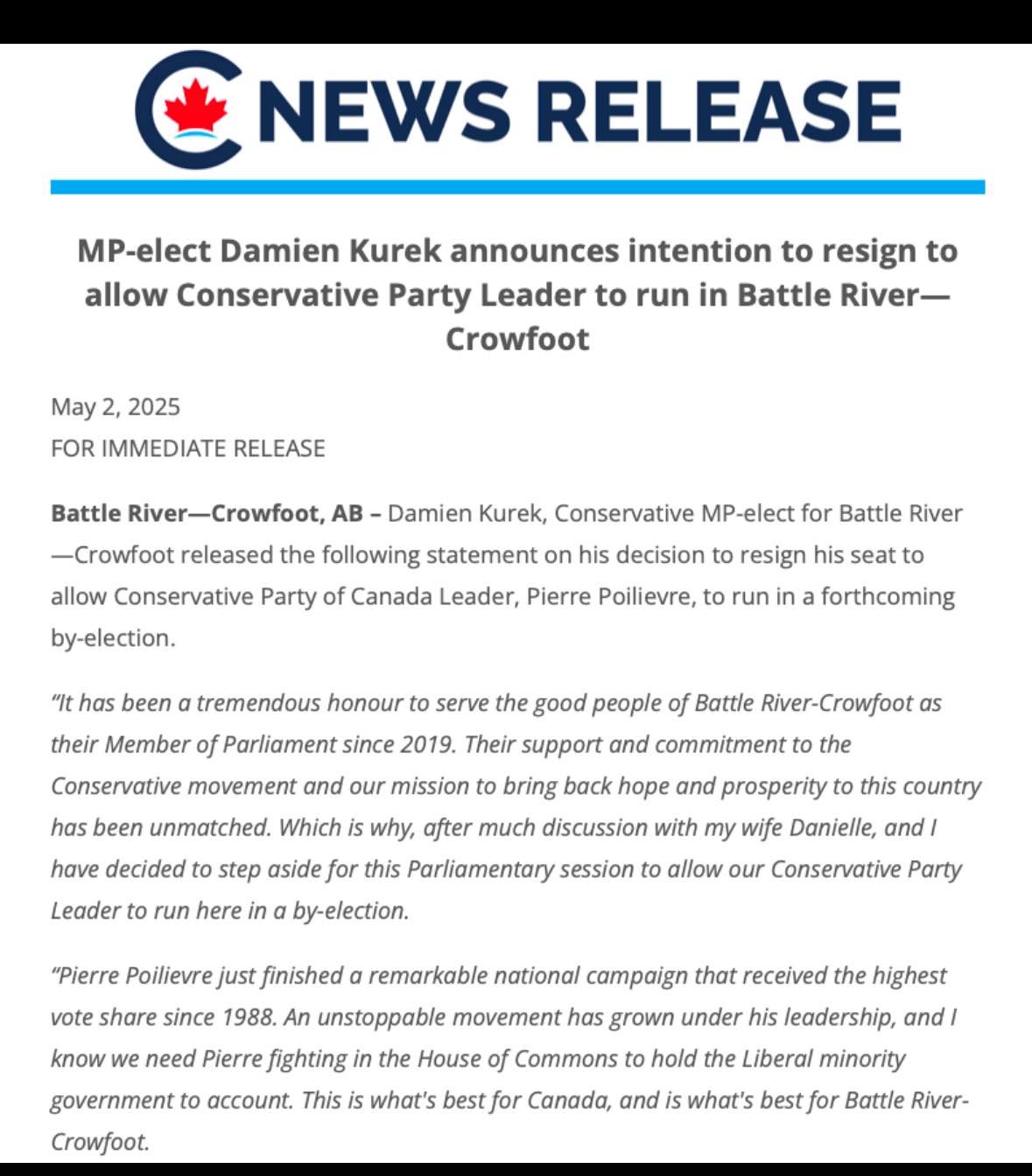

In most democracies, political defeat brings consequences. Leaders who lose their seats in an election are typically replaced, or they step aside gracefully. But in Canada’s uniquely malleable parliamentary system, losing an election doesn’t necessarily mean losing power. The Conservative Party’s latest maneuver—having Battle River–Crowfoot MP Damien Kurek resign to allow leader Pierre Poilievre to re-enter Parliament through a byelection—reveals how even democratic rules can be bent to protect partisan leadership, sometimes at the expense of democratic principles.
The Situation
Pierre Poilievre, the Conservative Party leader, lost his long-held Carleton seat in the April 29, 2025 federal election. Rather than initiating a leadership review or transition, the Conservative Party decided to keep Poilievre at the helm. Now, MP Damien Kurek will resign his Alberta seat, clearing the way for Poilievre to run in one of the safest Conservative ridings in the country.
Kurek’s decision was presented as a selfless act for the good of the party and the nation. In a public statement, he declared that Poilievre’s presence in the House of Commons is necessary to hold the Liberal minority government to account. Prime Minister Mark Carney quickly signaled that the byelection would be called promptly, avoiding any political delay.
Manipulating the Letter—If Not the Spirit—of Democracy
On the surface, nothing illegal has occurred. Canada’s parliamentary rules allow sitting MPs to resign and for party leaders to contest safe ridings when necessary. But legality does not always equal ethical governance.
Instead of recognizing the electorate’s decision in Carleton—a direct rejection of Poilievre personally—the Conservative Party has chosen to sidestep voters’ judgment by installing him in a different, far more politically secure riding. This move effectively tells Canadians that while their votes matter, party calculations matter more.
Such practices highlight a form of what might be called “Canadian corruption”: not the overt bribery or ballot-stuffing seen in fragile democracies, but a quiet, systemic manipulation where rules are used to subvert the public will under the guise of procedural legitimacy.
Historical Precedents—and the Erosion of Accountability
While this tactic has precedents in Canadian politics, it is increasingly seen as undemocratic. Historically, defeated party leaders either stepped down or waited for a future general election to seek re-entry. Canada’s political culture used to prize accountability and responsiveness to voter sentiment. By contrast, today’s hyper-partisan environment rewards strategic maneuvers that keep leaders in power at any cost.
Pierre Poilievre’s bypassing of electoral accountability sends a worrying message. If party loyalty and internal deals can override public verdicts, then the very essence of representative democracy—the idea that voters choose their leaders—is undermined.
Why It Matters Beyond the Conservatives
Critics might dismiss this as just a Conservative Party problem. But it’s a systemic issue that could easily be replicated across parties. When political systems enable any party leader to lose an election and simply shift ridings, it reduces elections to technicalities rather than authentic expressions of public choice.
Moreover, such actions deepen public cynicism. Canadians already express growing distrust in politicians and political institutions. Moves like this reinforce the belief that political elites operate under different rules, insulated from the consequences faced by ordinary citizens.
A Better Path: Leadership Renewal or Real Voter Accountability
There were alternative paths forward. The Conservatives could have embraced leadership renewal, allowing a new figure to emerge with a fresh mandate. Alternatively, Poilievre could have pledged to wait until the next general election to seek voter approval again.
Instead, the choice to engineer a “safe seat shuffle” demonstrates a short-term, win-at-all-costs mentality that prioritizes party survival over public trust.
Conclusion
Canada’s political system remains one of the world’s most stable and respected democracies. Yet stability is not immunity. The Poilievre byelection plan exposes how even strong systems can be manipulated when procedural rules are exploited for partisan advantage.
It’s a reminder that democracy is not just about following the rules—it’s about respecting their purpose. And when leaders forget that purpose, the voters must hold them to account. Not just at the ballot box, but in the court of public opinion, where the long-term health of Canadian democracy is truly judged.
To read more check
National Post: https://nationalpost.com/news/politics/alberta-mp-damien-kurek-stepping-down-for-poilievre-to-run-in-byelection
Lethbridge News Now: https://lethbridgenewsnow.com/2025/05/02/battle-river-crowfoot-mp-damien-kurek-to-resign-to-allow-pierre-poilievre-to-run-in-his-place/
Ladysmith Chemainus Chronicle https://www.ladysmithchronicle.com/home2/breaking-damien-kurek-to-resign-from-battle-river-crowfoot-7983192
Leave a Reply