
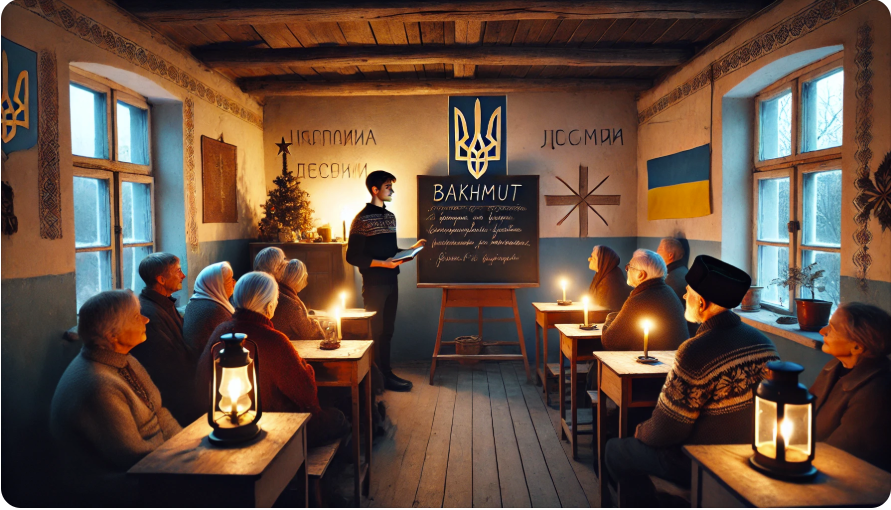

The winter sun cast long shadows through the windows of the Ukrainian Catholic Church in Kamloops as Sasha’s Ukrainian Diaspora Language Class gathered for their afternoon lesson. Today, the usual warmth in his smile carried a touch of solemnity as he welcomed his students.
“Today,” Sasha began, carefully arranging some printed sheets on his desk, “we’re going to learn a very special carol – ‘Там во Бахмуті‘ (There in Bakhmut). It’s different from our traditional carols, but equally important for our heritage.”
Olivia and Yuriy exchanged glances, having heard about Bakhmut in the news. A new student, Sofia, whose family had recently arrived from Ukraine, sat up straighter in her chair.
“Our people have always used carols to tell our stories,” Sasha explained, his voice gentle but firm. “Just as our ancestors sang about historical events, today’s Ukrainians create new carols to document our current history. This carol, written by Oleh Vitvitsky, shows how our Christmas traditions continue even in the most difficult times.”
He began writing the first verse on the board, pronunciation guides carefully noted beneath each line:
Там во Бахмуті, Де стріли чути, Де стільки цвіту Вже полягло…
“Here in Bakhmut, where shots are heard, where so many flowers have fallen,” Sofia translated quietly, her voice barely a whisper.
Sasha nodded encouragingly. “Yes, Sofia. The carol uses our traditional imagery – flowers representing lives – but tells a contemporary story. But notice what happens next in the carol…”
He wrote the response lines:
Враз тихо стало І залунало: Христос Родився! Славімо Його!
“Even there, they still celebrate Christmas,” Yuriy realized aloud. “They’re still singing ‘Christ is Born, Let us glorify Him.’”
“Exactly,” Sasha smiled, his eyes bright with emotion. “This carol shows us something very important about Ukrainian culture – how we maintain our traditions even in the hardest times. Each verse takes us to a different place: Bakhmut, Huliaipole, Mariupol…”
The class worked through each verse carefully, Sasha explaining the significance of each location, teaching new vocabulary, and helping them understand the deeper meanings. When they reached the verse about little Olia in Ternopil waiting for her father to return from the front, Sofia wiped away a tear.
“But notice,” Sasha said gently, “how the final verse brings hope: ‘Our family is all of Ukraine… Under God’s banner we march to victory.’ This carol isn’t just about documenting hardship – it’s about preserving hope and unity.”
As they practiced singing together, Sasha taught them about the carol’s structure, how it followed traditional Ukrainian carol patterns while incorporating modern elements. They learned new words: “окопна свічка” (trench candle), “звитяга” (victory), “промінь надії” (ray of hope).
“Why is it important for us to learn these songs here in Canada?” Sasha asked as they finished singing.
Olivia raised her hand. “Because we’re part of the story too. The verse about people singing in Rome shows that Ukrainians everywhere are connected.”
“And,” Yuriy added, “if we don’t remember and share these stories, who will?”
Sasha beamed at his students. “Exactly. As Ukrainian-Canadians, we have a responsibility to preserve and pass on not just our ancient traditions, but also the continuing story of our people. These new carols show that our culture is alive and evolving, not just preserved in museums.”
As the class ended, the students gathered their things, still humming the melody. Sofia approached Sasha with tears in her eyes but a smile on her face. “Дякую,” she said softly. “Thank you for helping us remember.”
“Next week,” Sasha announced as they left, “we’ll learn another new carol. Remember, every song we learn is another thread connecting us to our heritage, both past and present.”
The winter sun was setting as they left the church, but the warmth of their shared cultural connection lingered, bridging the distance between their Canadian home and their Ukrainian heritage, between past traditions and present realities.