

Dr. Oleksandr (Sasha) Kondrashov
Introduction
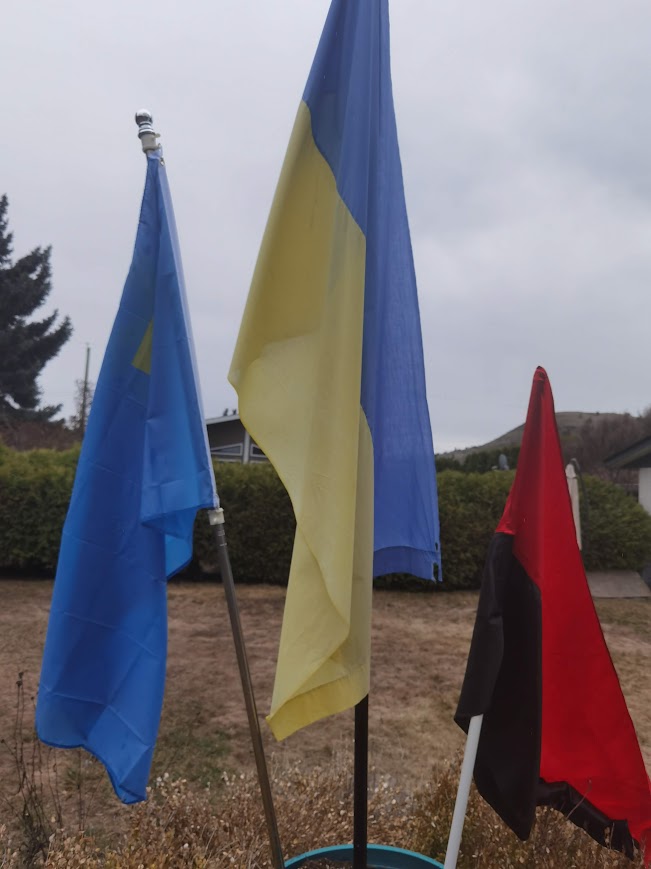
National flags are powerful symbols of a country’s identity, encoding its history, values, and aspirations. For Ukraine, a nation with a complex past marked by foreign domination, political upheaval, and a resilient struggle for self-determination, its national colours have taken on profound significance. The blue and yellow state flag, the less known red and black flag, and the flag of the Crimean Tatar people are all deeply interwoven with the Ukrainian people’s centuries-long quest for freedom and independence (Bivings, 2023; Ponomarenko, 2015; Karpov, 2007; DESS, 2023). This article explores the origins, evolution, symbolism, and political dimensions of these “freedom flags,” tracing how they have come to embody the spirit of the Ukrainian nation. It examines the ways in which the colours have been interpreted and politicized, both within Ukraine and by external actors like russia, and asserts Ukraine’s right as a sovereign nation to define the meaning of its own historical symbols.
The Blue and Yellow Flag: Eternal Skies Over Bountiful Wheat Fields

The iconic blue and yellow flag, which has served as Ukraine’s national flag since achieving independence in 1991, has a history stretching back at least seven centuries. The earliest known use of these colours in Ukrainian heraldry dates to the 13th century Galician-Volhynian Principality, whose coat of arms featured a golden lion on a blue shield (Bivings, 2023; Destinations.ua.,2023). Over the following centuries, blue and yellow flags were commonly flown by Cossack military units, such as those led by Bohdan Khmelnytsky in the 17th century Polish-Ukrainian War (Bivings, 2023; Ponomarenko, 2015). By the 19th century, as Ukrainian national consciousness grew, blue and yellow had become closely linked with the independence movement. During the short-lived Ukrainian People’s Republic of 1917-1921, various proposed national flags incorporated these colours (Bivings, 2023; Karpov, 2007).
The symbolism of the blue and yellow is deeply rooted in Ukraine’s natural landscape and agricultural heritage. The blue traditionally represents the boundless skies over Ukraine’s wide plains, while the yellow depicts the bountiful wheat fields that have made Ukraine the “breadbasket of Europe” (Bivings, 2023; Ponomarenko, 2015). Beyond this literal interpretation, the colours also carry rich metaphorical associations. Blue evokes qualities of peace, wisdom, and loyalty, while yellow signifies respect, generosity, and wealth (Bivings, 2023; Ponomarenko, 2015). Their adoption by Cossack armies and independence fighters also imbued them with connotations of martial valor and sacrifice for freedom.
Over time, the specific shades and arrangement of the colours have varied, reflecting evolving political and aesthetic sensibilities. The blue has ranged from sky to navy, the yellow from golden to pale lemon. The order of stripes has also alternated, sometimes blue over yellow, other times the reverse (Bivings, 2023; Petukhov & Pradid, 2002; Pradid, 2001; Karpov, 2007). Yet through all these variations, the essential colour scheme has endured, testifying to its deep resonance as a symbol of Ukrainian identity. In 1992, newly independent Ukraine officially adopted the blue and yellow flag, with blue on top, as its sole state flag (Bivings, 2023; Ponomarenko, 2015).
The Red and Black Flag: Blood of Heroes, Fertility of the Homeland

Less universally embraced but equally significant in Ukrainian history is the red and black flag. This colour combination first gained prominence in the 16th century through Cossack battle flags (Bivings, 2023; Pawliuk, 2015). But it was in the 20th century that it became indelibly associated with the struggle for Ukrainian independence. The Ukrainian Sich Riflemen, who fought in WWI, and later Ukrainian nationalist organizations in the interwar period adopted red and black flags, which were seen to symbolize the blood of fighters and the black soil of Ukraine (Pawliuk, 2015).
The most controversial but defining use of the red and black came during WWII with the Ukrainian Insurgent Army (UPA). This nationalist paramilitary group fought against both Soviet and Nazi forces in pursuit of an independent Ukraine, extensively using red and black banners (Bivings, 2023; Pawliuk, 2015; Desnianskyi District State Administration, 2020). In the war’s aftermath, as the Soviets brutally suppressed Ukrainian nationalism, the red and black flag became a potent emblem of resistance and anti-Soviet sentiment (Moroz, 2013; Right Sector, 2022).
In post-Soviet Ukraine, the red and black colours have continued to be used by some nationalist groups, particularly those claiming the UPA’s legacy (Pawliuk, 2015). This has made the flag a lightning rod for controversy and political division. Some see it as a proud symbol of Ukraine’s liberation struggle, while others associate it with the nationalist movement’s more radical and contentious elements (Moroz, 2013; Tereshchuk, 2014).
This complex history has been weaponized by russian propaganda, which paints the red and black flag as a fascist symbol in order to discredit Ukraine’s current government (Pawliuk, 2015; Noakes, 2022). russian media has falsely equated the UPA’s anti-Soviet resistance with Nazism, claims vigorously disputed by Ukrainian officials and historians, who point out the UPA fought both Soviets and Nazis (Moroz, 2013). Despite this controversy, the red and black remains an undeniable part of Ukrainian historical memory and national symbolism, a reminder of sacrifices made in the long fight for independence.
The Crimean Tatar Flag: Symbol of Indigenous Identity and Resistance

Alongside the blue and yellow and red and black, the flag of the Crimean Tatar people holds a special place in Ukraine’s pantheon of “freedom flags.” The Crimean Tatars are the largest indigenous people of Crimea and Ukraine as a whole, with a distinct identity formed on the territory of modern Ukraine (DESS, 2023). Their flag – a sky-blue field with a golden tamga (the coat of arms of the ruling Giray dynasty of the Crimean Khanate) in the top left corner – is thus not only a symbol of the Crimean Tatar ethnos but of an Indigenous People of Ukraine (Malbek, 2023).
The use of sky blue in Crimean Tatar flags has a long history, with the colour considered sacred and not used for war banners during the time of the Crimean Khanate (Ukrainian Institute of National Memory, 2020). After the Russian Empire’s annexation of the Khanate in 1783, the Crimean Tatar national revival began following the February Revolution of 1917. The first Qurultay (national congress) of the Crimean Tatar people in Bakhchysarai in December 1917 took place under sky-blue banners, and in 1919, the Crimean Tatar Parliament approved a sky-blue flag with the tamga as the national flag (Ukrainian Institute of National Memory, 2020).
During Soviet rule, the use of the national flag was prohibited. It was only after Ukraine gained independence that the sky-blue flag with the golden tamga was restored as the national flag at the second Qurultay in 1991 (Ukrainian Institute of National Memory, 2020). On July 5, 2021, the Verkhovna Rada of Ukraine adopted the Law “On the Indigenous Peoples of Ukraine,” which recognized the Crimean Tatars, along with the Karaites and Krymchaks, as indigenous Peoples of Ukraine. The law guarantees these peoples the right to self-determination, sustainable development, and protection of their identity (Verkhovna Rada of Ukraine, 2021). In this context, the Crimean Tatar flag symbolizes the centuries-long struggle of an Indigenous People for their rights, freedom, and identity.
Since the russian occupation of Crimea in 2014, the Crimean Tatar flag has become a symbol of resistance against occupation, the fight for the rights of Indigenous Peoples, the liberation of the peninsula, and the restoration of Ukraine’s territorial integrity (DESS, 2023). Despite prohibitions and persecution by the occupying authorities, Crimean Tatars continue to celebrate their national holidays and fly their flag. The Crimean Tatar flag flew on the Maidan alongside the Ukrainian flag during the Revolution of Dignity in 2013-2014, a symbol of the unity and solidarity of the Ukrainian and Crimean Tatar peoples in the struggle for freedom and a European choice (DESS, 2023).
Today, the Crimean Tatar flag can be seen at official events in Ukraine and abroad alongside the state flag of Ukraine, signifying the recognition of Crimean Tatars as an integral part of the Ukrainian political nation and support for their struggle for the de-occupation of Crimea (DESS, 2023). Refat Chubarov, head of the Mejlis of the Crimean Tatar people, has expressed hope that Crimean Tatar Flag Day will soon become an official national holiday in Ukraine, noting that the flag has earned a place in Ukrainian history through its existence and participation in defining events like the Revolution of Dignity (DESS, 2023).
The Politics and Poetics of Colour
Ukraine’s national colours have not only reflected the country’s identity and aspirations but have also become focal points for political contestation, both domestically and internationally. Within Ukraine, debates have arisen over the exact shades and arrangement of the blue and yellow flag (Pradid, 2001). Some advocate a lighter sky blue, others a darker azure; some argue for placing the yellow stripe above the blue. These discussions, while seemingly aesthetic, reveal deeper political and regional fault lines.
But it is on the international stage, particularly since russia’s 2014 annexation of Crimea and the ensuing conflict in eastern Ukraine, that the politics of Ukraine’s flag colours have been most fraught. russia has exploited the red and black flag’s complex history to paint Ukraine’s government as extremist and illegitimate (Pawliuk, 2015; Noakes, 2022). By fixating on this flag and making spurious associations with Nazism, russian propaganda aims to undermine the moral legitimacy of Ukraine’s struggle for sovereignty and territorial integrity.
Ukraine has forcefully countered these russian narrative attacks. Scholars and officials emphasize the red and black’s long history predating its use by WWII-era nationalists, arguing that Russia’s obsession with it deliberately distorts history to sow division in Ukraine (Moroz, 2013). In 2018, the law proposal was registered in Ukraine’s parliament to recognize the black and red flag as a flag of National Dignity. (Lb.ua, 2018). In 2023 petition was launched regarding the introduction of official use of the red and black flag (Ilʹyin, 2023) that did not receive needed signatures for consideration by the president of Ukraine. Ukraine has also been careful to distance itself from fringe nationalist elements and stress the blue and yellow’s primacy as the sole state flag (Visitukraine.today, 2022).
The Crimean Tatar flag, too, has been a focal point of political contestation. Its proud display by Crimean Tatars in defiance of russian occupation has made it a target of suppression by the occupying authorities (DESS, 2023). At the same time, its official recognition by the Ukrainian state, alongside the blue and yellow, is a powerful assertion of Crimean Tatars’ status as an indigenous people of Ukraine and of Ukraine’s commitment to their rights and freedoms (Verkhovna Rada of Ukraine, 2021). The flag’s sky-blue colour, evoking the boundless heavens, speaks to the Crimean Tatars’ ancient connection to their homeland, while the golden tamga is a proud symbol of their historic statehood and resilient identity (Malbek, 2023).
Beyond these politicized debates, Ukraine’s flag colours hold a poetic power as expressions of national identity and resilience. The blue and yellow, with its evocations of limitless skies and golden wheat fields, connects Ukrainians to their landscape and agricultural roots, and to their timeless yearning for peace and prosperity (Ponomarenko, 2015). The red and black testifies to the sacrifices made for independence and the unyielding determination to resist subjugation (Desnianskyi District State Administration, 2020; Tereshchuk, 2014).
In moments of crisis, these colours have been rallying points for solidarity and resistance. During the 2004 Orange Revolution and 2014 Revolution of Dignity, the blue and yellow flag was the ubiquitous emblem of Ukraine’s democratic aspirations (Ponomarenko, 2015). Today, as Ukraine faces existential threats, the flag’s defiant display in the face of aggression symbolizes national cohesion and resolve (Rubryka.com, 2023).
For the Ukrainian diaspora, too, the flag colours are powerful ties to the homeland and expressions of cultural pride. Displayed at parades and rallies, woven into folk art and embroidery, they are perpetual reminders of heritage and identity even far from Ukraine’s borders (Ponomarenko, 2015; Visitukraine.today, 2022).
The story of Ukraine’s colours, in the end, mirrors the story of Ukraine itself – a history of oppression and resilience, of division and unity, of an inextinguishable longing for freedom and self-determination. From medieval heraldry to the banners of the Maidan, these colours have endured as symbols of the Ukrainian spirit (Ponomarenko, 2015). While their meanings may be contested, their emotive power is undeniable.
Conclusion
The blue and yellow, the red and black, and the Crimean Tatar flag – Ukraine’s “freedom flags” – are vivid threads in the complex tapestry of Ukrainian identity, woven through centuries of struggle and hope. The blue and yellow of the state flag speak to Ukrainians’ bond with their land and their dreams of peace and abundance (Ponomarenko, 2015). The red and black testify to the sacrifices of the independence struggle and the fierce resolve to resist domination (Desnianskyi District State Administration, 2020; Right Sector, 2022). The sky-blue and golden colours of the Crimean Tatar flag are a powerful assertion of indigenous identity and an emblem of resistance against occupation (DESS, 2023; Malbek, 2023).
As Ukraine faces ongoing threats to its sovereignty, the defiant display of these flags is a potent declaration of an unbowed national will (Visitukraine.today, 2022; Rubryka.com, 2023). The story of Ukraine’s colours, mirroring the nation’s own story, is still being written. But undoubtedly, all these flags will remain central characters in this unfolding narrative – not just as symbols, but as declarations of identity, of the right to self-determination, and of the unwavering pursuit of a free and democratic future for all the peoples of Ukraine.
References:
Bivings, L. (2023). Everything you didn’t know about Ukraine’s flag. The Kyiv Independent. Retrieved March 27, 2024, from https://kyivindependent.com/everything-you-didnt-know-about-ukraines-flag/
Desnianskyi District State Administration. (2020, August 27). Що означає червоно-чорний прапор? (What does the red and black flag mean?). Retrieved from https://desn.kyivcity.gov.ua/news/15399.html
DESS. (2023, June 22). Кримськотатарський прапор є втіленням сенсів національної єдності, спадковості поколінь і прагнення до свободи. https://dess.gov.ua/krymskotatarskyy-prapor-ie-vtilenniam-sensiv-natsionalnoi-iednosti-spadkovosti-pokolin-i-prahnennia-do-svobody/
Destinations.ua. (2023). The path to independence: Interesting facts about the national symbols of Ukraine. Retrieved March 27, 2024, from https://destinations.ua/culture/culture/1128-the-path-to-independence-interesting-facts-about-the-national-symbols-of-ukraine
Ilʹyin, G.A. (2023, January 3). Щодо запровадження офіційного використання червоно-чорного прапора (Regarding the introduction of official use of the red and black flag). Retrieved from https://petition.president.gov.ua/petition/175094
Karpov, V. (2007). Військові прапори України (Military flags of Ukraine). Kyiv. Retrieved from https://er.nau.edu.ua/bitstream/NAU/53309/1/%d0%92%d1%96%d0%b9%d1%81%d1%8c%d0%ba%d0%be%d0%b2%d1%96%20%d0%bf%d1%80%d0%b0%d0%bf%d0%be%d1%80%d0%b8%20%d0%a3%d0%ba%d1%80%d0%b0%d1%97%d0%bd%d0%b8.pdf
Lb.ua. (2018, March 30). У Раду внесено законопроект про статус червоно-чорного прапора (A bill on the status of the red and black flag has been submitted to the Rada). Retrieved from https://lb.ua/news/2018/03/30/394005_radu_vnesen_zakonoproekt_statuse.html
Malbek, R. (2023, June 26). Золото на блакиті. Прапор кримських татар від появи – до наших днів (фотогалерея). https://ua.krymr.com/a/photo-prapor-krymskykh-tatar-vid-poiavy-do-nashykh-dniv/30691925.html
Moroz, V. (2013, October 18). “Прапор червоно-чорний – це наше знамено…”. Яким був стяг УПА? (“The red and black flag is our banner…” What was the banner of the UPA?). Istorychna Pravda (Historical Truth). Retrieved from https://www.istpravda.com.ua/articles/2013/10/18/138044/
Noakes, T. C. (2022, March 4). Why a photo of Freeland holding a black-and-red scarf sparked a firestorm online. CBC News. Retrieved from https://www.cbc.ca/news/politics/freeland-nationalist-scarf-1.6372995
Pawliuk, I. (2015, April 6). “Гей-гу, гей-га”: чи дійсно червоно-чорний прапор був офіційним прапором ОУН? (“Hey-hoo, hey-ha”: was the red and black flag really the official flag of the OUN?). Retrieved from https://gazeta.ua/articles/history/_gejgu-gejga-chi-dijsno-chervonochornij-prapor-buv-oficijnim-praporom-oun/586468
Petukhov, L. A., & Pradid, Y. F. (2002). Державний Прапор України: синьо-жовтий чи жовто-блакитний, чи…? (State Flag of Ukraine: blue-yellow or yellow-blue, or…?). Visnyk Natsionalnoho universytetu vnutrishnikh sprav (Bulletin of the National University of Internal Affairs), 17, 174-178. http://irbis-nbuv.gov.ua/cgi-bin/irbis_nbuv/cgiirbis_64.exe?C21COM=2&I21DBN=UJRN&P21DBN=UJRN&IMAGE_FILE_DOWNLOAD=1&Image_file_name=PDF/VKhnuvs_2002_17_35.pdf
Ponomarenko, L. (2015). Прапор України як архетип цілісності і символ інтеграційних прагнень держави (The flag of Ukraine as an archetype of integrity and a symbol of the state’s integration aspirations). Suspilna polityka (Public Policy), 130-135. http://irbis-nbuv.gov.ua/cgi-bin/irbis_nbuv/cgiirbis_64.exe?C21COM=2&I21DBN=UJRN&P21DBN=UJRN&IMAGE_FILE_DOWNLOAD=1&Image_file_name=PDF/Pubupr_2015_1%28spets.__23.pdf
Pradid, Y. F. (2001). Ще раз про кольори державного прапора України. (Once again about the colours of the state flag of Ukraine) Культура народов Причерноморья. http://dspace.nbuv.gov.ua/bitstream/handle/123456789/108385/37-Pradid.pdf?sequence=1
Right Sector. (2022, March 7). Що означає червоно-чорний прапор? (What does the red and black flag mean?). Retrieved from https://spilno.org/article/scho-oznachaye-chervono-chornyi-prapor
Rubryka.com. (2023). Symbol of hope: a look at the meaning of the Ukrainian flag. Retrieved from https://rubryka.com/en/article/ukrainian-flag/
Tereshchuk, H. (2014, February 3). Червоно-чорний прапор став символом протестної боротьби – геральдист (The red and black flag has become a symbol of protest struggle – heraldist). Radio Svoboda. Retrieved from https://www.radiosvoboda.org/a/25251033.html
Ukrainian Institute of National Memory. (2020, June 26). День кримськотатарського прапора. https://uinp.gov.ua/istorychnyy-kalendar/cherven/26/den-krymskotatarskogo-prapora
Verkhovna Rada of Ukraine. (2021, July 21). Law of Ukraine on Indigenous Peoples of Ukraine. https://zakon.rada.gov.ua/laws/show/1616-20#Text
Visitukraine.today. (2022). National Flag Day of Ukraine: what you should know about the blue and yellow symbol of invincibility. Retrieved from https://visitukraine.today/blog/2439/national-flag-day-of-ukraine-what-you-should-know-about-the-blue-and-yellow-symbol-of-invincibility
Leave a Reply