

Introduction
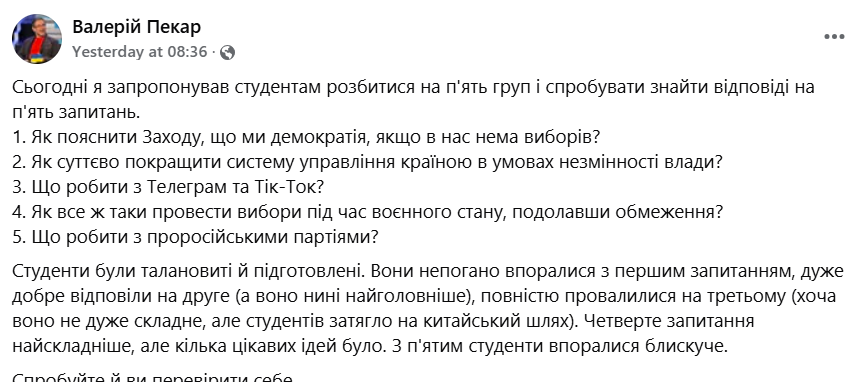
Recently, Valerii Pekar posed five crucial questions to his students about Ukraine’s democratic challenges during wartime. These questions sparked important discussions about governance, democratic values, and national security in times of war. Building on this foundation, let’s explore these challenges through both practical and social work perspectives, while highlighting the constraints imposed by limited financial and military support and Russia’s ongoing efforts to undermine Ukraine’s institutions.
The Democratic Paradox
Pekar’s students tackled the complex question of explaining Ukraine’s democratic nature despite the absence of elections. Their responses, while not fully detailed in the original post, highlighted the importance of looking beyond electoral processes. Social work principles emphasize democracy as a holistic concept that encompasses civil society engagement, protection of human dignity, and institutional resilience.
Historical precedents, such as the United Kingdom during World War II, demonstrate that democracies can maintain their essential character even when traditional democratic processes are temporarily suspended. For Ukraine, this resilience is visible in its active civil society, vibrant free press, and the unity of its people despite severe financial constraints and wartime challenges.
Governance Without Change
The students reportedly performed “very well” on the question of improving governance under unchanged leadership. This aligns with social work’s emphasis on systemic improvement and institutional strengthening. Enhancing transparency, accountability mechanisms, and civic engagement is crucial. Ukraine faces immense pressure as resources are diverted to defense, but improving governance through technology, local empowerment, and partnerships with civil society can offset the limitations imposed by unchanged leadership. Building robust systems and processes ensures governance effectiveness even amid significant constraints.
The Digital Battlefield
Pekar noted that students “completely failed” on the question of Telegram and TikTok, being drawn toward a “Chinese path.” This underscores the challenge of balancing security concerns with digital freedoms, especially when these platforms are exploited by adversaries. A more balanced approach, informed by social work values of harm reduction and empowerment, would focus on:
- Digital Literacy: Educating citizens to critically analyze information.
- Content Moderation: Collaborating with platforms to mitigate misinformation.
- Positive Engagement: Amplifying credible Ukrainian voices.
This strategy respects freedoms while countering Russia’s propaganda efforts and addressing the vulnerabilities of an open digital space.
Elections Under Martial Law
This was described as the most challenging question, with students offering several interesting ideas. Wartime elections present technical and philosophical challenges that must be addressed with innovation and commitment to democratic principles. Social work values suggest solutions that ensure participation and security, such as:
- Secure Digital Voting: Developing systems accessible to displaced persons and military personnel.
- International Oversight: Ensuring transparency and legitimacy through global partnerships.
- Provisional Local Elections: Testing limited elections in safer regions as a phased approach.
These measures require financial and logistical support, which remains a critical challenge given Ukraine’s constrained resources.
The Pro-Russian Party Question
Students reportedly excelled at addressing the question of managing pro-Russian parties. From a social work perspective, this issue involves balancing national security with democratic freedoms. Effective solutions include:
- Legal Enforcement: Applying existing laws to hold individuals accountable for activities that undermine national sovereignty.
- Civic Education: Countering divisive ideologies through education and community building.
- Institutional Strengthening: Ensuring that democratic processes are resilient to manipulation.
Given Russia’s ongoing efforts to destabilize Ukrainian governance, these measures are essential to maintaining political stability and safeguarding democratic values.
The Challenges of Limited Support
Ukraine’s ability to address these challenges is hindered by limited financial and military resources. International support remains crucial, as the country cannot effectively counter Russian aggression or strengthen its institutions without external aid. Despite these limitations, Ukraine’s resilience and commitment to democracy are evident in its innovative approaches to governance and its determination to protect sovereignty.
Looking Forward
As Pekar’s exercise demonstrated, these questions have no simple answers. However, by combining practical governance considerations with social work values of dignity, justice, and community engagement, Ukraine can forge a path that maintains democratic principles even under wartime conditions. The students’ varying success with different questions reflects the complexity of these challenges and the need for multifaceted approaches.
Conclusion
The intersection of Pekar’s classroom exercise and social work principles offers valuable insights into Ukraine’s democratic challenges. Success in navigating these issues will require wisdom, patience, and unwavering commitment to democratic values, even as the nation faces external threats. Ukraine’s experience in addressing these challenges may well provide important lessons for other democracies facing similar pressures in an increasingly complex world. By upholding democratic principles amidst adversity, Ukraine exemplifies the resilience and adaptability necessary to sustain democracy under siege.
Here is the summary of answers to Pekar’s questions through the lens of social work values:
- How to explain to the West that we are a democracy when we don’t have elections? The focus should be on demonstrating Ukraine’s ongoing commitment to democratic values and human rights even under extraordinary circumstances:
- Emphasize the temporary nature of election postponement due to protecting citizens’ safety and rights during wartime
- Highlight continued functioning of civil society organizations, free press, and public discourse
- Show examples of government accountability to citizens through various feedback mechanisms
- Point to historical precedents like the UK during WWII where democratic nations suspended elections
- How to significantly improve the country’s governance system with unchanging leadership? Focus on strengthening institutional processes and civic engagement:
- Enhance transparency and accountability mechanisms
- Strengthen local governance and community participation
- Expand meaningful consultation with civil society organizations
- Create robust oversight mechanisms and independent monitoring
- Improve public service delivery systems
- Strengthen anti-corruption measures and institutional safeguards
- What to do about Telegram and TikTok? Take a balanced approach that respects both security needs and individual rights:
- Develop digital literacy programs to help citizens critically evaluate information
- Work with platforms to improve content moderation while protecting free speech
- Create positive, engaging Ukrainian content as alternatives
- Support Ukrainian content creators to build strong national presence
- Focus on education rather than restriction
- How to conduct elections during martial law, overcoming limitations? Consider carefully phased approaches that prioritize both democratic participation and security:
- Start with local elections in secure regions as pilot programs
- Develop secure digital voting systems with international verification
- Ensure special provisions for military personnel and displaced persons
- Maintain transparency and international observation
- Create mechanisms to prevent interference and manipulation
- What to do about pro-Russian parties? Address this through legal and social frameworks rather than purely restrictive measures:
- Apply existing laws regarding national security consistently and fairly
- Focus on evidence-based enforcement rather than broad restrictions
- Address root causes through education and community building
- Strengthen democratic institutions that make extremist views less appealing
- Support programs that promote social cohesion and national unity
The key is maintaining a balance between security needs and democratic values, while building stronger institutions and engaged communities that can sustain democracy in the long term.