
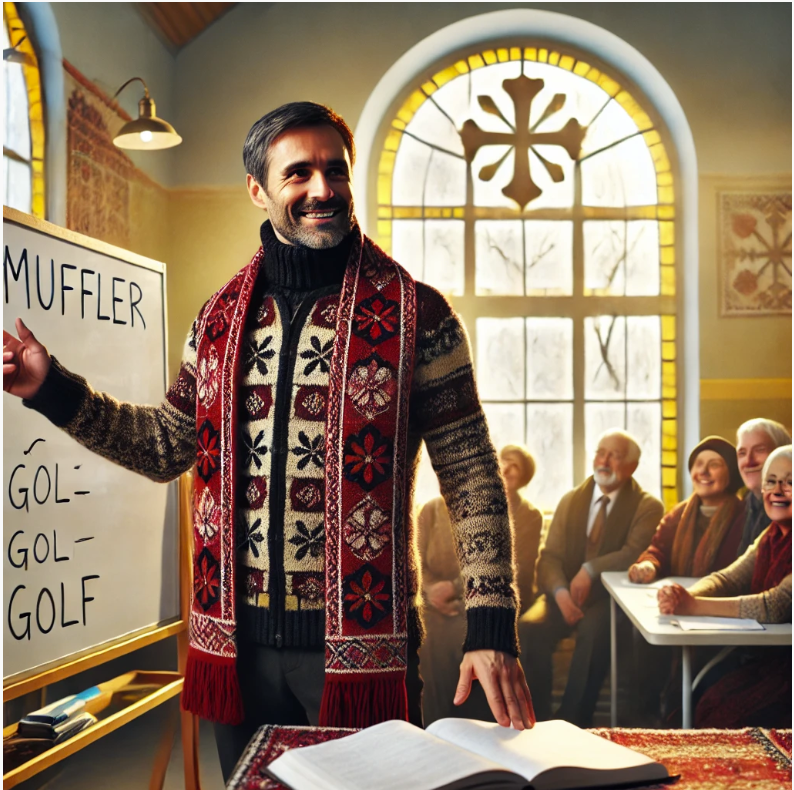

It was a particularly cold Saturday in Kamloops when Sasha greeted his Ukrainian Diaspora Language Class, his own мuffler (шарф/sharf) wrapped snugly around his neck. The classroom windows were frosted over, making it the perfect day to discuss winter clothing vocabulary.
“Today,” Sasha announced with his characteristic warm smile, “we’re going to have some fun with winter clothing terms that might cause confusion between English and Ukrainian!”
He wrote “muffler” on the board. “Now, who knows what this means in English?”
Yuriy, the older gentleman, raised his hand eagerly. “That’s the thing that makes my old car quieter – or at least it used to!” The class chuckled.
“Yes!” Sasha nodded. “But in English, it’s also this!” He tugged at his scarf. “In Ukrainian, we simply say ‘шарф‘ (sharf). So imagine the confusion when a Ukrainian mechanic gets asked to fix a muffler and shows up with a warm scarf!”
The students laughed, particularly as Sasha acted out wrapping a car in a scarf.
Next, he wrote “golf” on the board. “Now, this is where it gets really interesting. What does this mean in English?”
Olivia, a second-generation Ukrainian-Canadian, spoke up. “That’s the sport with the little balls and clubs, right?”
“Exactly! But in Ukrainian, ‘гольф‘ (golf) also means something completely different,” Sasha explained, pointing to his neck. “It means ‘turtleneck sweater’! Imagine a Ukrainian grandmother telling her grandson to wear his golf in the winter, and he shows up with golf clubs!”
The class burst into laughter, and Yuriy added, “That explains why my wife was so confused when I said I was going golfing. She kept asking why I needed a new sweater for that!”
Sasha continued, writing more winter clothing terms: “We have ‘рукавички‘ (rukavychky) for gloves, ‘шапка‘ (shapka) for hat, and ‘чоботи‘ (choboty) for boots. But my favorite is still how we can confuse English speakers by talking about our golf collection!”
A young student raised her hand. “My mom once told her English-speaking friend she had twenty golfs in her closet. Her friend thought we were millionaires with a golf club collection!”
As the class wrapped up, Sasha adjusted his muffler – the scarf kind – and smiled at his students. “Remember, whether you’re wearing a golf or playing golf, staying warm is what matters. Just maybe specify which kind of muffler you need when you go shopping!”
The students left that day not only with new vocabulary but also with amusing stories to share about the quirks of learning two languages. For Sasha, these linguistic mix-ups were the perfect way to keep his students engaged while connecting them to their heritage. After all, nothing brings people together quite like laughing about wearing your golf while fixing your muffler on a cold winter day.