

The Ukrainian language sings. Its rhythmic cadences and melodic vowels are the threads that have woven the cultural fabric of Ukraine for over a thousand years. Ukrainian is infused with history, poetry, song, and storytelling – it gives voice to the spirit of the Ukrainian people.
Yet over generations of external domination, many Ukrainians were stripped of their native tongue. Russian and Polish authorities suppressed the Ukrainian language for fear its survival would kindle the fires of nationalism. Russification policies banned Ukrainian language books, newspapers, schools. Many Ukrainians reluctantly surrendered their linguistic identity to spare their children persecution for speaking their mother language.
Ukraine has shaken off the shackles of imperialism, but linguistic oppression has left scars. As the country healed from its wounded past, linguistic uniformity was touted as the way to consolidate the nation. But this thinking fails to grasp an essential truth: The unity of Ukraine lies not in homogeneity but in diversity.
As in any living language, Ukrainian has naturally adopted regional dialects, accents, vocabularies over its long history. But rather than weaken national identity, these local flavors enliven and strengthen Ukrainian cultural heritage. Just as patches on the traditional vyshyvanka emblemize the country’s diverse threads woven into a unified whole, the versions of spoken Ukrainian capture the spirit of the land and its people.
The melodious Polissian dialect hums in the misty forests of Ukraine’s north. The rollicking steppe draws out the joyful song of south-central Ukraine’s dialect. The vivid metaphor of the Carpathian variant echoes in the mountains of the west. The texture of the Ukrainian language is enriched by each colorful strand of regional speech.
Some argue literary Ukrainian is the most prestigious form – the tongue of great poets like Shevchenko and Franko. But as linguists emphasize, no dialect is superior to others. Each version carries ancestry and identity important to understanding Ukraine’s complex cultural landscape.
Rather than impose artificial standards, Ukraine should nurture an integrative policy embracing pluralism over purity. Leading linguists advocate teaching standard Ukrainian in schools while fostering respect for village talk used in villages. Authors can bring visibility to dialects by incorporating regional words and phrases into modern literature. Media can host talk shows in the cadence of local speech.
By safeguarding the diversity of Ukrainian language, the lyrical soul of the people finds full expression. And in this polyphony of voices, the rich heritage woven over centuries resonates in harmony. The tongue that binds Ukraine is musical not because it conforms to fixed rules but because it celebrates its many melodies.
The winds now blow fair for spreading one’s native wings. A cultural renaissance has spurred enthusiasm for reclaiming spoken Ukrainian from all walks of life. Informal Ukrainian speaking groups are blossoming in cities across the country. Urban youth are rediscovering the retro appeal of village vernaculars. Town squares ring out with tongues once hushed.
But even many eager to break out in their mother language hesitate, self-conscious their pronunciation or grammar may betray imperfect learning. Such awkwardness is understandable given the ruptures of history. Yet authenticity matters more than accuracy in reviving a lost tongue. One need not achieve textbook standards to contribute to the cause – participation is its own purpose.
The language of the present is inclusive, patient, understanding. Native speakers have a special duty here. Rather than nitpick assumed errors, celebrate courage in communication. See not shortcoming but an opportunity to guide gently. Converse in the spirit of solidarity, not superiority. Each encounter is a chance to dissolve embarrassment around the Ukrainian tongue, to restore its lyrical lilt to everyday exchange.
For those newly acquainted, focus more on listening and appreciating early on rather than worrying about mistakes in speaking. Let the words wash over as melodious waves before attempting to vocalize them. Familiarity will embolden first steps. And use need not remain purely practical – play with the language also for pleasure. Puzzle out tongue twisters, sing traditional songs, lose oneself in village poems and oral tales. Performance builds confidence and deeper cultural connection.
However halting the progress, the attempt itself advances collective healing. Even fractured Ukrainian carries poetry – the Reconstruction era after Bolshevik repression proved language can thrive on remnants. An accent influenced by Russian or Surzhyk spice only demonstrates the resilience of linguistic culture under strain. Such imperfections are not deficiencies but badges of survival.
Speak not because you must, but because through Ukrainian you can. Its linguistic identity will continue to evolve, as it has for ages. Don’t fret if your diction would bewilder ancestors – they would surely pardon slips in grammar just to hear Ukrainian once more on new generations’ lips.
The Ukrainian language lives through its people. From fireside epic ballads to shouted rallying cries in the Maidan, it is the soul of this ancient land vocalized anew by fresh voices. Its continued existence is not just about preserving heritage but progressing as a society. Tongues join together in song – and through harmony, build the foundation for a shared future.
So open your mouth, let Ukrainian spill freely without filter. Don’t mute yourself for fear of misspeaking. Sing the speech of your grandparents and village elders. Spin new versions with regional rhythms. This language is yours by birthright – claim it, speak it, spread it. In voices everywhere retelling old stories and starting new ones, the Ukrainian spirit stirs, arises, triumphs. The tongue that ties us together makes every voice stronger. Let this language soar again on the currents of liberty.
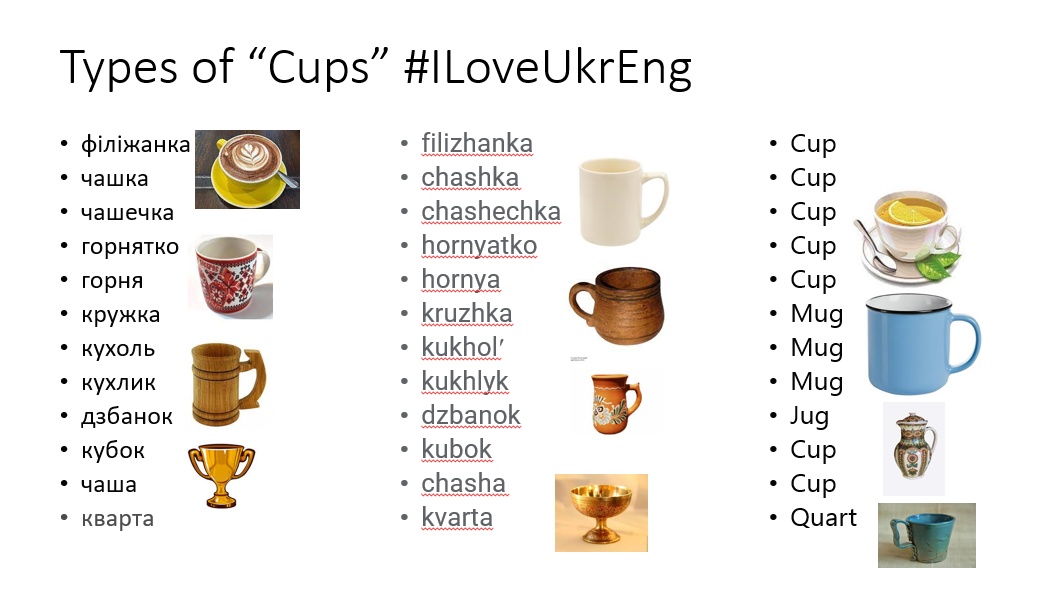
What is the way you say cup in Ukrainian?
