

This week my whole feed has been full of pictures of the Crimean bridge. I am glad to see it broken. It was never a bridge between neighbours. It was built as a symbol of colonization, occupation and Russia’s illegal annexation of Crimea, and as a road to carry an army and keep control over Ukrainian land.
It is only one bridge, but it is a powerful reminder that empires do not last. The Russian warship went where it was told to go. This bridge has fallen into the sea. One day the occupation will go too, and Ukraine will win. The sad part is how many lives this costs. Russia will not stop on its own, and every day Ukrainians pay for that with their lives. I hold that grief together with the hope.
Two bridges, one week in November 2022
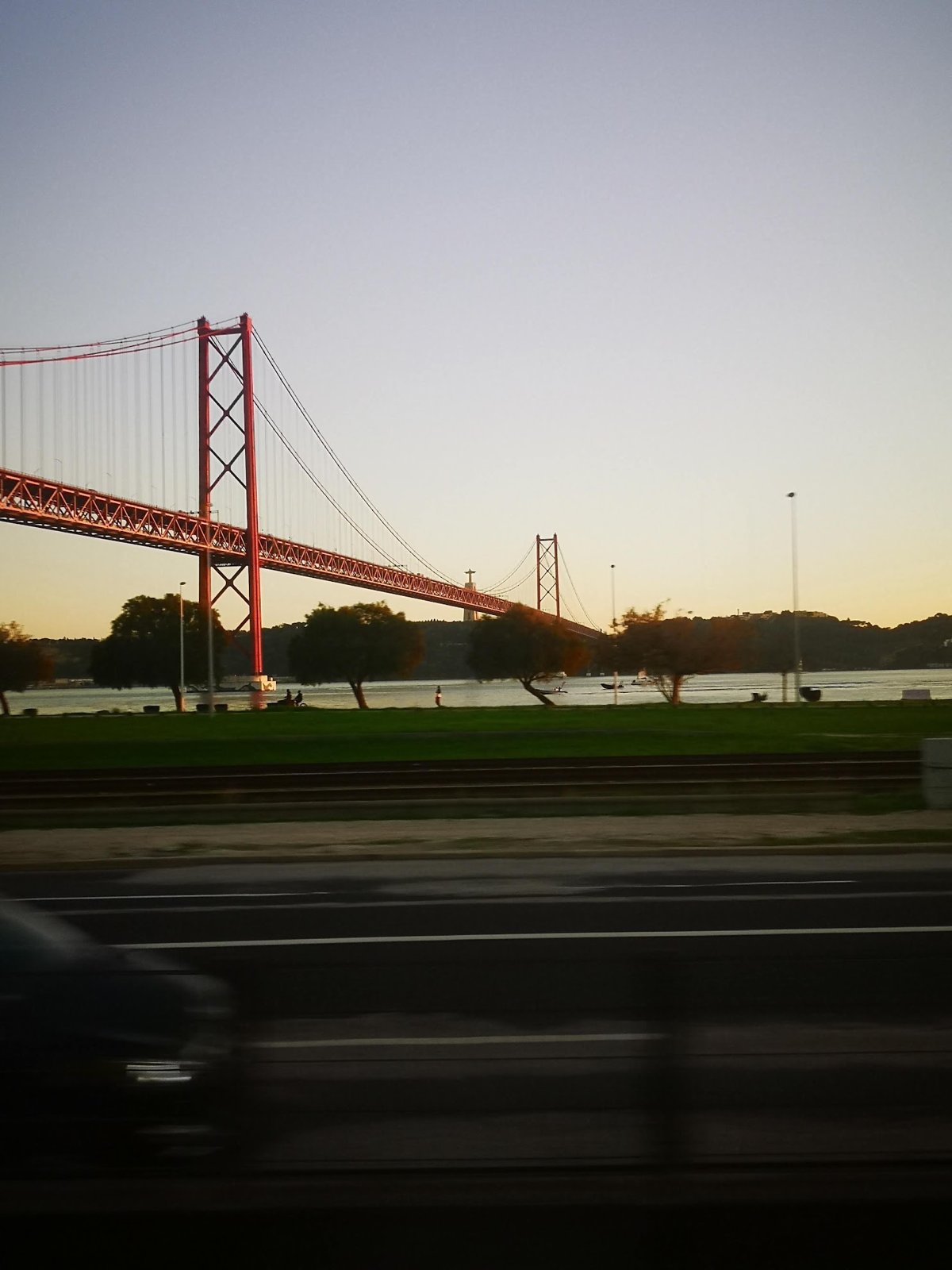
In November 2022 I stood by the Tagus River in Lisbon and photographed a red suspension bridge glowing at sunset. That same week, far to the east, retreating Russian troops blew up the Antonivskyi road and railway bridges across the Dnipro at Kherson, along with smaller bridges in the region (Euromaidan Press, 2022; Ukrainska Pravda, 2022). One bridge was carrying people home from work, and other bridges were being destroyed so that people could not follow.
A bridge that changed its name
The bridge in my photo opened on August 6, 1966, as the Salazar Bridge, named after the Prime Minister who ruled Portugal as a dictator and ordered it built. After the Carnation Revolution of April 25, 1974, which ended that regime, it was renamed the 25 de Abril Bridge (Structurae, n.d.-b). The steel stayed the same, but the meaning changed. A monument to one man became a monument to the day people took their country back.
Europe’s longest bridge, again
Upriver is Lisbon’s other crossing, the Vasco da Gama Bridge. It opened in 1998 for Expo 98 and runs about 12.3 km, almost all of it viaduct (Structurae, n.d.-a). It held the title of Europe’s longest bridge for twenty years, until 2018, when Russia opened its roughly 19 km bridge across the Kerch Strait to occupied Crimea (WorldAtlas, n.d.).
On November 16 and 17, 2026, Ukrainian strikes hit that bridge twice within 24 hours. More than 270 metres of span fell into the sea, the roadway became unusable, and the railway tracks were damaged. The fallen section also blocked the shipping channel out of the Sea of Azov, and repairs could take months (JAMnews, 2026; Kabachynskyi, 2026). A bridge with a gap in the middle is no longer a crossing. For now, the longest intact bridge in Europe is once again the one in a democracy, built for a world’s fair that celebrated connecting continents.
Why this bridge matters
I do not celebrate the destruction of any bridge lightly. Bridges are among the most human things we build. But the Kerch bridge was built across Ukrainian land that Russia annexed illegally in 2014. It has been used to move military supplies into Crimea and on to the front, and the land route that remains runs through occupied Ukrainian territory (JAMnews, 2026; Kabachynskyi, 2026). Taking it out of use is not about steel and concrete. It protects Ukrainian lives in the south by closing a supply road for an army that keeps destroying Ukrainian homes, schools, and the bridges ordinary people need.
The Red Bridge at home

Kamloops knows what it means to lose a bridge. I took this photo on an autumn afternoon in October 2021, standing on the sand under the old wooden trusses with the river calm and the cottonwoods turning gold. Three years later, the bridge was gone. On September 19, 2024, our Red Bridge burned and three spans fell into the South Thompson River (CFJC Today, 2025).
It was the first bridge in Kamloops. Its first official name was Government Bridge, but people called it the Red Bridge after the red cedar it was built from. For generations it was a culturally significant link between the city and Tk’emlúps te Secwépemc (The Wren, n.d.). Since the fire, more traffic has been pushed onto the Overlanders Bridge, and city councillors have pressed the province for an update on the replacement (CFJC Today, 2025).
You can see a difference here. In Kamloops, the loss of a bridge led to public questions, council debate, pressure on the province, and the voices of First Nations and neighbours. People can disagree with how slowly it moves, and many do. That is what accountability looks like.
Roads to people, roads to power
I came to Canada with two suitcases, so I think about roads a lot. In a democracy, transportation belongs to the public. People argue about it, pay for it, and expect it to serve everyone, including people with disabilities, who notice first when a bus route, ramp, or crossing disappears. In an empire, roads and bridges serve power first. They become showpieces, supply lines for occupation, and things to blow up when an army retreats. Portugal shows that a bridge built under a dictator can come to belong to free people. Ukraine is fighting for the same chance.
I will return to Lisbon to photograph the Vasco da Gama Bridge. Until then, I keep these pictures, one from Kamloops in October 2021 and two from Lisbon in November 2022, and a hope that every bridge in Ukraine will one day carry people home in peace.
Love. Care. Share.
References
CFJC Today. (2025, August 11). Kamloops councillors seek update on bridge replacement plans, to press province on need for two new structures. https://cfjctoday.com/2025/08/11/kamloops-councillors-seek-update-on-bridge-replacement-plans-to-press-province-on-need-for-two-new-structures/
Euromaidan Press. (2022, November 11). Retreating Russian troops blow up two bridges in Kherson (updated). https://euromaidanpress.com/2022/11/11/retreating-russian-troops-blow-up-two-bridges-in-kherson/
JAMnews. (2026, November). Part of Crimean Bridge collapses into sea: What damage to one of Kremlin’s key propaganda symbols means. https://jam-news.net/?p=238603
Kabachynskyi, I. (2026, November 17). Ukrainian strike sends more than 270 meters of Russia’s Crimean Bridge into the sea. How bad is the damage? United24 Media. https://united24media.com/war-in-ukraine/ukrainian-strike-sends-more-than-270-meters-of-russias-crimean-bridge-into-the-sea-how-bad-is-the-damage-24435
Structurae. (n.d.-a). Vasco da Gama Bridge. https://structurae.net/en/structures/vasco-da-gama-bridge
Structurae. (n.d.-b). 25 de Abril Bridge (Tagus River Bridge). https://structurae.net/en/structures/tagus-river-bridge
The Wren. (n.d.). Why is the Red Bridge fire so devastating for Kamloops? History has the answers. https://thewrennews.ca/?p=4902
Ukrainska Pravda. (2022, November 11). Antonivka Bridge is completely destroyed, propagandists say it was blown up by occupiers. https://www.pravda.com.ua/eng/news/2022/11/11/7375899/
WorldAtlas. (n.d.). The longest bridges in Europe. https://www.worldatlas.com/articles/longest-bridges-in-europe.html
Leave a Reply