
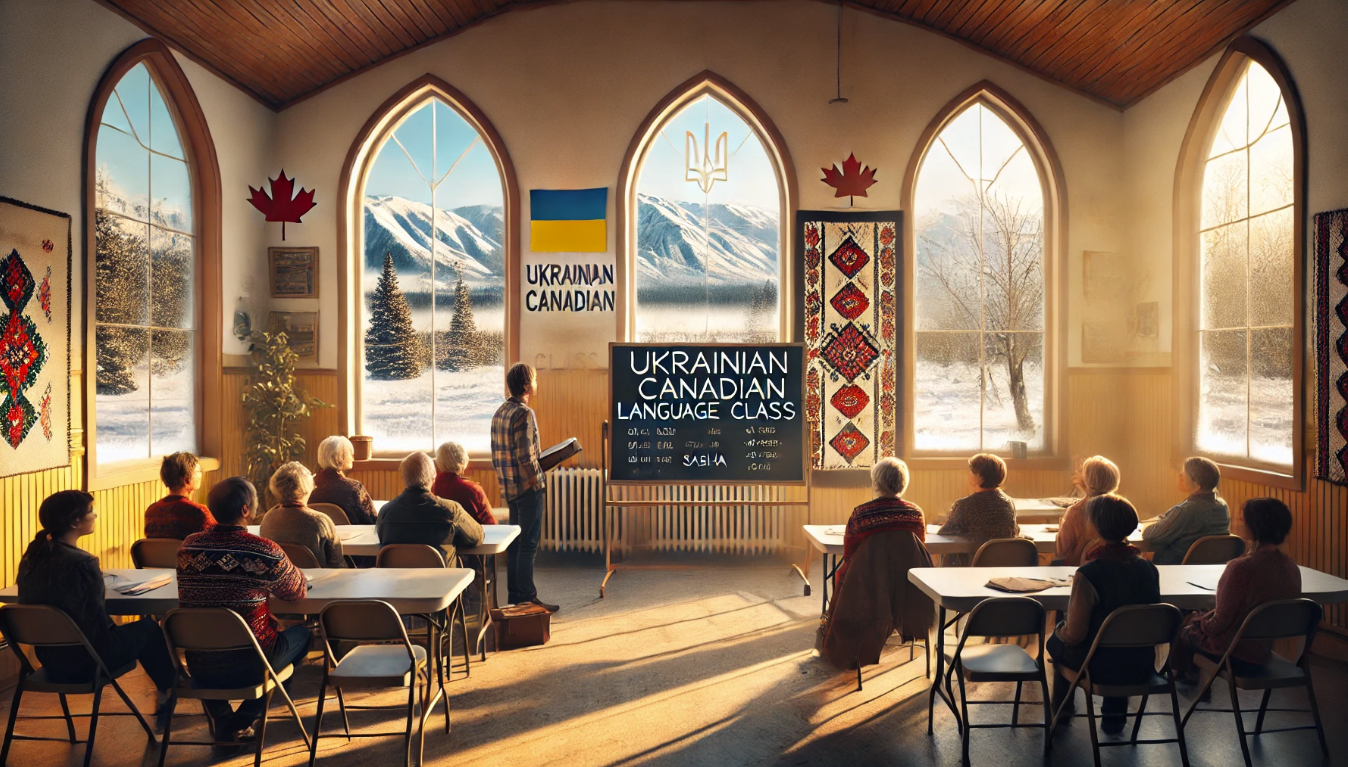

On a crisp November morning in Kamloops, Sasha welcomed his students to another session of the Ukrainian Diaspora Language Class. As the cold mountain air seeped through the windows, the warm classroom provided a perfect setting to explore the deep connections between language and faith.
Sasha greeted students with his usual warm smile as they filled the room. “Last week, we explored Ukrainian Church Terminology, but today, we’re looking at something even deeper—the language of faith, using both English and Ukrainian idioms!”
The students looked intrigued, especially as Sasha started by writing “Act of God” on the board. “Who here knows what this means?”
Olivia, a second-generation Ukrainian-Canadian, raised her hand. “Isn’t that something beyond our control, like a natural disaster?”
“Exactly!” Sasha nodded. “In Ukrainian, we say ‘Воля Божа’ (Volya Bozha), which translates to ‘God’s Will.’ It reminds us that some things are outside human influence. Just like how ‘Act of God’ describes forces beyond us, ‘Воля Божа’ is a reminder of life’s uncontrollable aspects.”
The students nodded thoughtfully. Sasha continued, adding another phrase to the board: “Patience of a Saint.”
“Now, in English, we say someone has the ‘patience of a saint’ when they can stay calm through difficult times. In Ukrainian, we say ‘мати ангельське терпіння’ (maty anhelske terpinnya) or ‘to have angelic patience.’ While saints in English symbolize extreme patience, in Ukrainian, it’s the angels who embody this quality.”
Yuriy, the older gentleman who had moved to Kamloops decades ago, chuckled. “Ah, that must be why my wife calls me an angel when I don’t complain about her cooking!”
The class burst into laughter, and Sasha added with a grin, “Yes, Yuriy! ‘Having angelic patience’ can apply to all of us, especially when we’re being kind to each other!”
Sasha moved on to his next idiom: “Devil’s advocate.” He explained how, in English, it means someone who argues for the sake of debate. “In Ukrainian, we say ‘Адвокат диявола’ (Advokat dyiavola), which translates directly. Both expressions remind us that sometimes, even ‘the devil’ has an advocate—someone who pushes us to think harder.”
Through the classroom window, they could see snow beginning to dust the Thompson Valley as Sasha introduced “To wash one’s hands of something.” In English, it meant absolving oneself of responsibility, inspired by Pontius Pilate’s actions. “In Ukrainian, we say ‘Умити руки’ (Umyty ruky), which means ‘to wash hands.’ It’s the same action, symbolizing walking away from something without taking responsibility.”
“That sounds familiar,” said Yuriy, raising his eyebrows. “Like when my kids won’t take the blame for breaking something.”
“Exactly, Yuriy,” Sasha replied with a grin. “The act of ‘washing one’s hands’ can cross cultures!”
He continued with a well-known idiom: “To turn the other cheek.” In English, it symbolized responding to aggression with forgiveness. “In Ukrainian, we say ‘Підставити іншу щоку’ (Pidstavyty inshu shchoku), or ‘to offer the other cheek.’ The meaning is the same, but it reminds us of our shared values of patience and forgiveness.”
The class was absorbed, especially as Sasha brought up “to sell one’s soul.” “In English, this means to betray one’s principles for personal gain, just like in Ukrainian, where we say ‘Продати душу дияволу’ (Prodaty dushu dyiavolu)—’to sell one’s soul to the devil.’ This reminds us that our soul, our conscience, is something sacred.”
As the afternoon light filtered through the windows, Sasha concluded with a story. “There’s a Ukrainian saying: ‘Коли рак на горі свисне’ (Koly rak na hori svysne) or ‘when the crayfish whistles on the mountain.’ In English, we say, ‘when hell freezes over.’ Both idioms express something impossible or unlikely. It’s like saying, ‘I’ll believe it when I see it!’”
As the class wrapped up, Sasha smiled at his students. “These expressions—’Воля Божа,’ ‘мати ангельське терпіння,’ ‘Адвокат диявола’—connect us. They remind us that faith, hope, and morality are universal, bridging generations of Ukrainian-Canadians here in Kamloops.”
As the students bundled up against the November chill, they took with them not only phrases but also a sense of connection to their heritage. Through these idioms, they carried ancient beliefs with them, keeping their culture alive in the heart of British Columbia. For Sasha, that was the real magic—bringing their shared heritage to life, one idiom at a time.
Leave a Reply