

This article was inspired by a thought-provoking Facebook post by Ukrainian writer Andriy Lyubka, shared on October 13, 2023. In his post, Lyubka observed a growing divide within the Ukrainian diaspora in Canada, particularly between those who arrived before the full-scale Russian invasion in 2022 and those who came after. The post, which can be found at https://www.facebook.com/photo?fbid=8372899562745012&set=a.205071282861255, sparked a lively discussion in the comments section, revealing the complexity and diversity of experiences within the Ukrainian-Canadian community. The following article expands on Lyubka’s observations and the ensuing discussion, exploring the historical context, current challenges, and potential paths forward for the Ukrainian diaspora in Canada. It aims to provide a balanced perspective on the “Two Diasporas” phenomenon, acknowledging the realities faced by both long-established community members and recent arrivals.
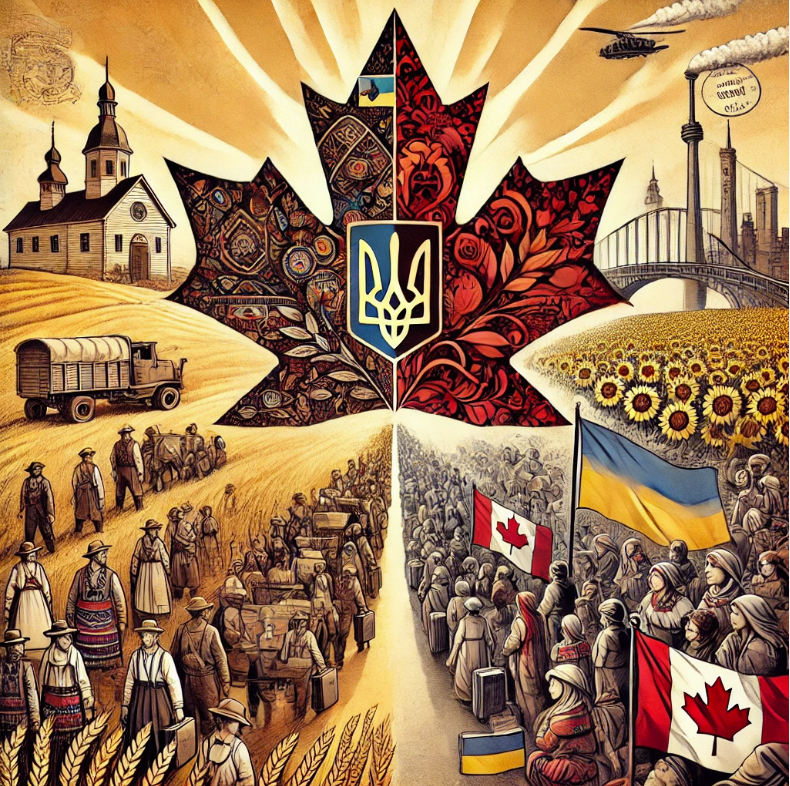
The Ukrainian diaspora in Canada has a rich and complex history, shaped by multiple waves of immigration over more than a century. Recent observations, however, have highlighted a growing divide within this community, particularly between those who arrived before the full-scale Russian invasion of Ukraine in 2022 and those who came after. This phenomenon, dubbed “Two Diasporas,” reflects deeper issues of identity, integration, and the challenges faced by newcomers in a foreign land.
Historical Context
Canada has seen several waves of Ukrainian immigration, each bringing its own unique characteristics and challenges. The timing of each wave is not always the same as some authors also have a separate wave for those who came after 1952 and until Ukraine Independence in 1991, but generally the six waves can be traced:
- First Wave (1891-1914): Primarily agricultural settlers from Western Ukraine
- Second Wave (1923-1939): Interwar immigrants, including political refugees
- Third Wave (1945-1952): Post-World War II displaced persons
- Fourth Wave (1990s-2014): Ukraine independence immigrants
- Fifth Wave (2014-2022): Immigrants following the annexation of Crimea
- Sixth Wave (2022-present): Refugees and immigrants fleeing the full-scale Russian invasion
Each of these waves has contributed to the mosaic of Ukrainian-Canadian identity, but has also faced unique challenges in integration and acceptance.
The Current Divide
The most recent observation of a divide within the Ukrainian-Canadian community centers on two main groups:
- Established Diaspora: Ukrainians born abroad or who emigrated earlier, including descendants of previous waves.
- New Arrivals: Ukrainians who left Ukraine after the start of the full-scale invasion in 2022.
Paradoxically, as time passes, these two “camps” seem to be growing further apart rather than coming together, harboring mutual resentment and disdain.
Factors Contributing to the Divide
Several factors contribute to this growing divide:
- Different Experiences of Migration: Earlier immigrants often faced more challenging paths to establishing themselves in Canada, while recent arrivals have received more immediate support due to their refugee status.
- Perceptions of Ukraine: Long-established diaspora members may have a more romanticized or outdated view of Ukraine, while recent arrivals bring contemporary perspectives and experiences.
- Language and Cultural Differences: Newer arrivals may be more likely to speak Russian or surzhyk, which can create tension with Ukrainian-speaking diaspora members.
- Competition for Resources: There may be perceived competition for support from Canadian institutions and the established Ukrainian-Canadian community.
- Differing Priorities: Recent arrivals may be more focused on immediate needs and supporting family back in Ukraine, while established diaspora members may prioritize long-term community building and cultural preservation.
The Impact of Canadian Attitudes
The way Canadians have treated Ukrainian immigrants throughout history also plays a role in shaping the diaspora’s internal dynamics. Early Ukrainian settlers faced discrimination and were often viewed as “enemy aliens” during World War I. Over time, as Ukrainians became more integrated into Canadian society, attitudes shifted. The warm welcome extended to recent Ukrainian refugees has been notably different from the reception of earlier waves, potentially creating resentment among some longer-established community members.
Challenges and Hopes
The concerns raised by this divide are very real for many newcomers. They may feel isolated, misunderstood, or judged by the established diaspora. Meanwhile, longer-term residents may feel their efforts to maintain Ukrainian culture and identity are underappreciated or challenged by newcomers.
However, there is hope that people will find ways to connect and support each other. Many community organizations, churches, and individuals are working to bridge the gap between different waves of immigrants. Events that celebrate Ukrainian culture, language classes, and support groups for newcomers can all help to foster understanding and unity.
Moving Forward
For those who struggle to find common ground, it’s important to remember that it’s okay to create strong boundaries and focus on finding their own way in Canada. Not every Ukrainian-Canadian will have the same experience or perspective, and that diversity can be a strength rather than a weakness.
As the situation in Ukraine continues to evolve, and as newer arrivals settle into life in Canada, the dynamics within the Ukrainian-Canadian community will likely continue to shift. The challenge – and the opportunity – lies in finding ways to honor the diverse experiences and perspectives within the community while working towards common goals of supporting Ukraine and preserving Ukrainian culture in Canada.
Ultimately, the story of the Ukrainian diaspora in Canada is one of resilience, adaptation, and ongoing evolution. By acknowledging the challenges and working towards greater understanding, the community can hope to bridge the divide between its “two diasporas” and emerge stronger and more united.