
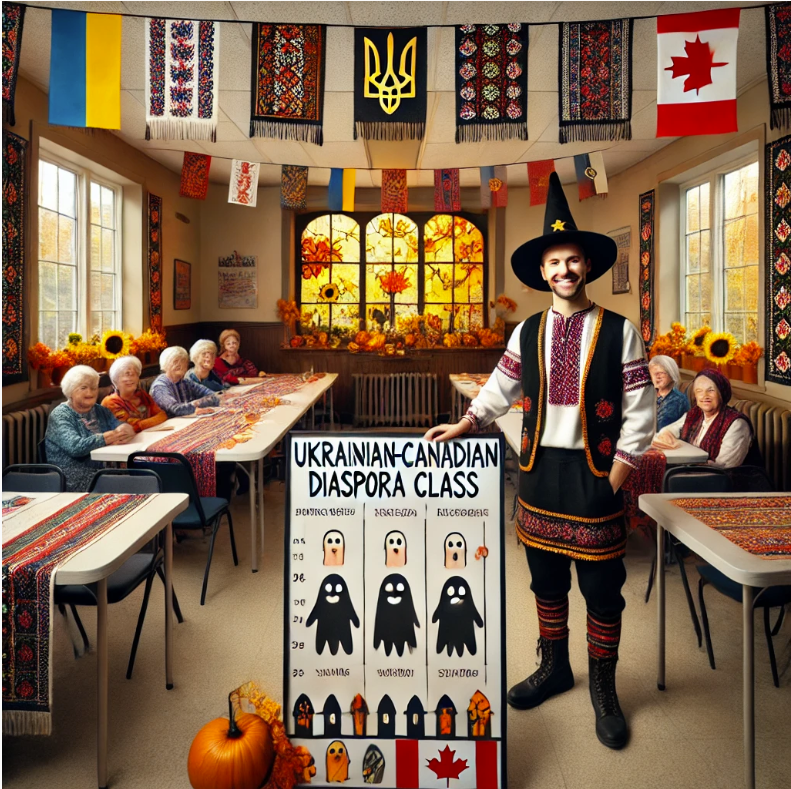

I have asked AI to help me design the second Halloween lecture, including images using examples from previous Ukrainian Diaspora Language classes. Although today we will be learning church terminology, if you are interested in doing a second Halloween-themed Ukrainian Diaspora Language Class, here are some suggestions:
Sasha couldn’t wait for the next Ukrainian Diaspora Language Class. While Halloween wasn’t traditionally Ukrainian, the Ukrainian-Canadian community embraced this North American tradition as an opportunity to explore their rich mythological heritage. The previous week’s lesson on Halloween vocabulary had sparked such enthusiasm that he decided to dive deeper into the topic. After all, the diaspora experience was about growing and adapting while keeping their ancestral stories alive.
As the students filed in, chattering excitedly, Sasha greeted them with a mysterious smile. “Last week, we learned about ‘Відьма’, ‘Чарівник’, and ‘Упир’. But guess what? Looking through our folklore, we’ve got even more fascinating creatures to add to our collection: ‘Домовий’ and ‘Водяник’!”
The class erupted in a mix of wonder and spooked murmurs. Olivia, the second-generation Ukrainian-Canadian, raised her hand. “Wow, that’s so many mythical beings! How do we know which one lives where?”
Sasha chuckled. “Great question, Olivia! Each creature has its own domain and story. Let’s map out their homes: ‘Домовий’ is our house spirit who protects the family home, while ‘Водяник’ rules the waters with his fishtail and green mustache. ‘Мавка’ lives in the Carpathian forests and appears as a beautiful woman, but beware – she has no skin on her back! And ‘Чугайстер’, our cheerful forest man, loves to dance and actually protects humans from mischievous Мавки!”
After letting the new creatures sink in, Sasha clapped his hands together. “Now, while our neighbors are preparing for Halloween with their ghosts and vampires, let’s explore our own supernatural beings!”
Olivia was quick to contribute. “Oh! My бабуся always warns us about leaving food for Домовий when we move into a new house. She says he’s like a grumpy grandfather who needs to be respected!”
Sasha’s eyes lit up. “Прекрасно! Perfect comparison, Olivia. In fact, Домовий is believed to be an ancestor watching over the family. While Western homes might have security systems, our ancestors had Домовий!”
Yuriy, the older gentleman, chuckled from his usual spot. “Speaking of home spirits, my wife blames Злидні whenever things go missing. She says they must be living under our stove!”
The class erupted in laughter as Sasha explained, “Ah yes, Злидні – the poverty spirits! They’re tiny troublemakers who can empty your pantry faster than teenage kids! That’s why traditional homes had protective symbols woven into their рушники (embroidered towels).”
As the lesson progressed, Sasha introduced more creatures, drawing comparisons with Halloween favorites:
“Before there was Dracula, we had Упир – our ancient vampire, recognizable by his red face and little hair. Unlike modern vampires, he has two hearts, making him twice as hard to defeat!”
“Instead of the Boogeyman, Ukrainian children were warned about Бабай, who takes children who won’t sleep. Though nowadays, I think він боїться iPhone – he’s afraid of iPhones!” Sasha joked, making the students laugh.
“And our Вовкулака isn’t just any werewolf – you can spot him by his grown-together eyebrows, even in human form. He actually appears on the emblem of Ukraine’s Special Operations Forces!”
Towards the end of class, Sasha decided to challenge his students. “Now, who can tell me what protections our ancestors used against these creatures?”
The room fell silent until Olivia’s face lit up. “Oh! For Мавка, you need garlic and horseradish! And for Упир, you need an aspen stake… but bring friends because of the two hearts!”
“Чудово!” Sasha beamed with pride. “And what about Домовий?”
Yuriy raised his hand. “That’s easy – just keep a peaceful home and leave him some kutia on holidays. My grandmother always did that.”
As the class wound down, Sasha looked around the room, heart swelling with joy. “You see, my friends, while we embrace new traditions like Halloween, our own folklore is filled with fascinating creatures. From Мавка to Чугайстер, from Домовий to Водяник, each being tells a story about what our ancestors valued and feared. When you share these tales, you’re not just speaking Ukrainian; you’re keeping our ancestral wisdom alive.”
The students nodded, their connection to their roots growing stronger with each mythical being they discovered. As they left the classroom, excitedly comparing Ukrainian creatures with Halloween monsters, Sasha couldn’t help but smile.
“До побачення!” Sasha called out as the last student left. “And remember, ‘Хто Домового шанує, той в хаті добро чує!’ (‘Who respects Domovyi finds good fortune at home!’)”
Laughter echoed through the halls as the students departed. As Sasha watched them head home through the decorated streets of Kamloops, where carved гарбузові ліхтарі (jack-o’-lanterns) glowed on porches and friendly neighbors prepared treats for tomorrow’s trick-or-treaters, he reflected on how the Ukrainian-Canadian diaspora had grown. Their ancestors had brought with them not just language and customs, but a rich tapestry of mystical beings who still had lessons to teach. Now, as children prepared to dress as zombies and vampires, they also carried with them the ancient knowledge of Мавки and Упирі, creating a unique blend of old world wisdom and new world celebrations.
Leave a Reply