
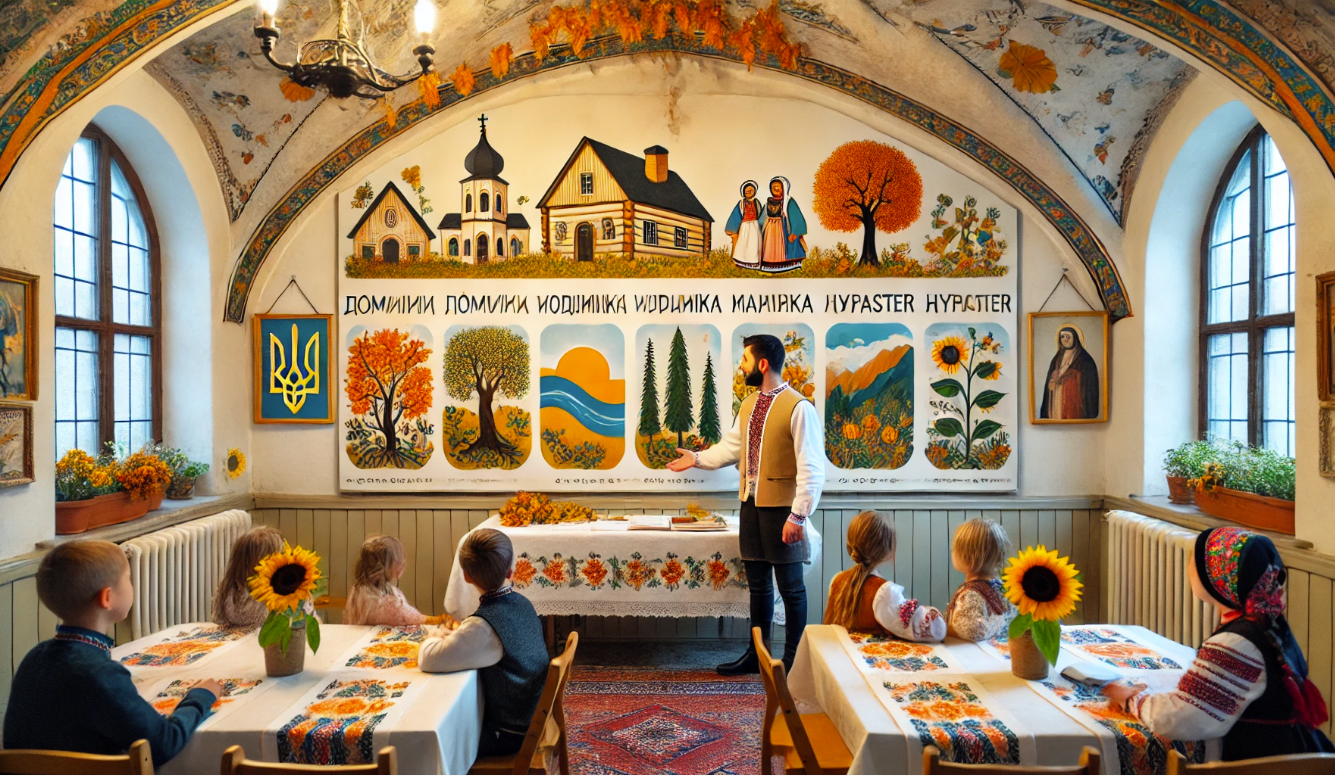

I have asked AI to help me design the Halloween lecture, including images using examples from previous Ukrainian Diaspora Language classes. Although today we will continue learning church terminology, if you are interested in doing a Halloween-themed Ukrainian Diaspora Language Class, here are some suggestions:
Sasha could barely contain his excitement as Halloween approached. After last week’s successful lesson on mouth idioms, he had transformed his Ukrainian Diaspora Language Class into a haunted classroom filled with paper гарбузи (pumpkins) and павутина (cobwebs).
As students filed in, their eyes widening at the dimly lit room illuminated by електричні свічки (electric candles), Sasha greeted them wearing a чарівник (wizard) hat. “Remember how we learned five different words for ‘mouth’ last week? Well, today we’re going to learn even more exciting vocabulary – all about Halloween!”
Olivia, the second-generation Ukrainian-Canadian, raised her hand with familiar enthusiasm. “My бабуся says Ukrainians didn’t traditionally celebrate Halloween. Are we kind of making our own tradition here?”
“Прекрасне питання!” Sasha beamed. “While Halloween isn’t traditionally Ukrainian, our діаспора has embraced it while keeping our language alive.
Yuriy, the older gentleman, chuckled from his usual spot. “In my day, we were more scared of Домовий than зомбі!”
The class erupted in laughter as Sasha pointed to the decorations around the room. “Let’s start with what we can see. What’s this?”
“Oh! That’s a гарбуз!” called out Olivia, pointing to a jack-o’-lantern.
“Close!” Sasha grinned. “When it’s carved with a face, we call it гарбузовий ліхтар. And what’s that hanging next to it?”
“Кажан!” several students shouted, pointing to the paper bat.
The classroom buzzed with energy as Sasha introduced more Halloween creatures. “Now, let’s explore some supernatural beings from both Ukrainian folklore and Halloween traditions!”
Olivia was quick to contribute again. “Oh! My дідусь tells me scary stories about упир! Is that like a вампір?”
“Excellent connection!” Sasha explained. “Упир is actually an ancient Ukrainian word that influenced the modern concept of vampires. We also have чорт (devil), відьма (witch), and привид (ghost). Each has its own fascinating history in Ukrainian folklore!”
As the lesson progressed, students eagerly shared their costume plans:
“Я буду чарівником, як ви, Сашо!” (I’ll be a wizard like you, Sasha!) “А я буду скелетом!” (And I’ll be a skeleton!) “Я хочу бути чорним котом!” (I want to be a black cat!)
Towards the end of class, Sasha taught them the Ukrainian way to say “trick-or-treat”: “Цукерки або капость!”
The students practiced the phrase, giggling at how different it sounded from the English version. Then Sasha posed a challenge: “Who can create a spooky sentence using our new vocabulary?”
Olivia, true to form, raised her hand first: “У моторошному будинку живуть привиди та кажани!” (Ghosts and bats live in the haunted house!)
“Фантастично!” Sasha clapped. “You’re all becoming masters of Ukrainian vocabulary! Remember, these words aren’t just for Halloween—привид, відьма, and чарівник appear in many Ukrainian fairy tales and stories throughout the year.”
As the class wound down, Sasha distributed small bags of цукерки (candies), just as he had done during their first mouth-words lesson. “Next week, we’ll learn about День всіх святих (All Saints’ Day) and how different cultures honor their ancestors.”
The students gathered their belongings, chattering excitedly about their new spooky vocabulary. Before they left, Yuriy called out, “Careful, Sasha! With all these decorations, people might think you’re a справжній чарівник!”
Laughter echoed through the halls as the students departed. Sasha began taking down the decorations, feeling grateful for how Halloween had become a beautiful example of community spirit. From the families in Kamloops who decorated their homes with гарбузові ліхтарі and паутина, to the generous neighbors who prepared bags of цукерки for visiting children, the holiday had become a wonderful way to share both treats and traditions.
He smiled, thinking about how celebrations like these brought people together across cultures. Whether they were first-generation Ukrainian-Canadians like himself or families who had lived in Kamloops for generations, Halloween night would find them all sharing the same streets, the same joy, and the same spirit of community. It was more than just a holiday—it was a bridge between cultures, a chance for children to experience the warmth of neighborhood togetherness, and an opportunity for everyone to be part of something bigger than themselves.
Leave a Reply